Alcidae
Black Guillemot
Cepphus grylle
- Scientific name
- Cepphus grylle
- Family
- Alcidae
- In Sweden
- Partial migrant, breeds here
- Size
- 34 to 37 cm
- Swedish Red List 2025
- Not red-listed
- Global Red List (IUCN)
- Least concern (LC)
The Black Guillemot breeds on stony shores, cliffs and islands, in Sweden both on the west coast and in the Baltic. Mink have pushed it out to the outer archipelagos and islands far from the mainland.
How to recognise it
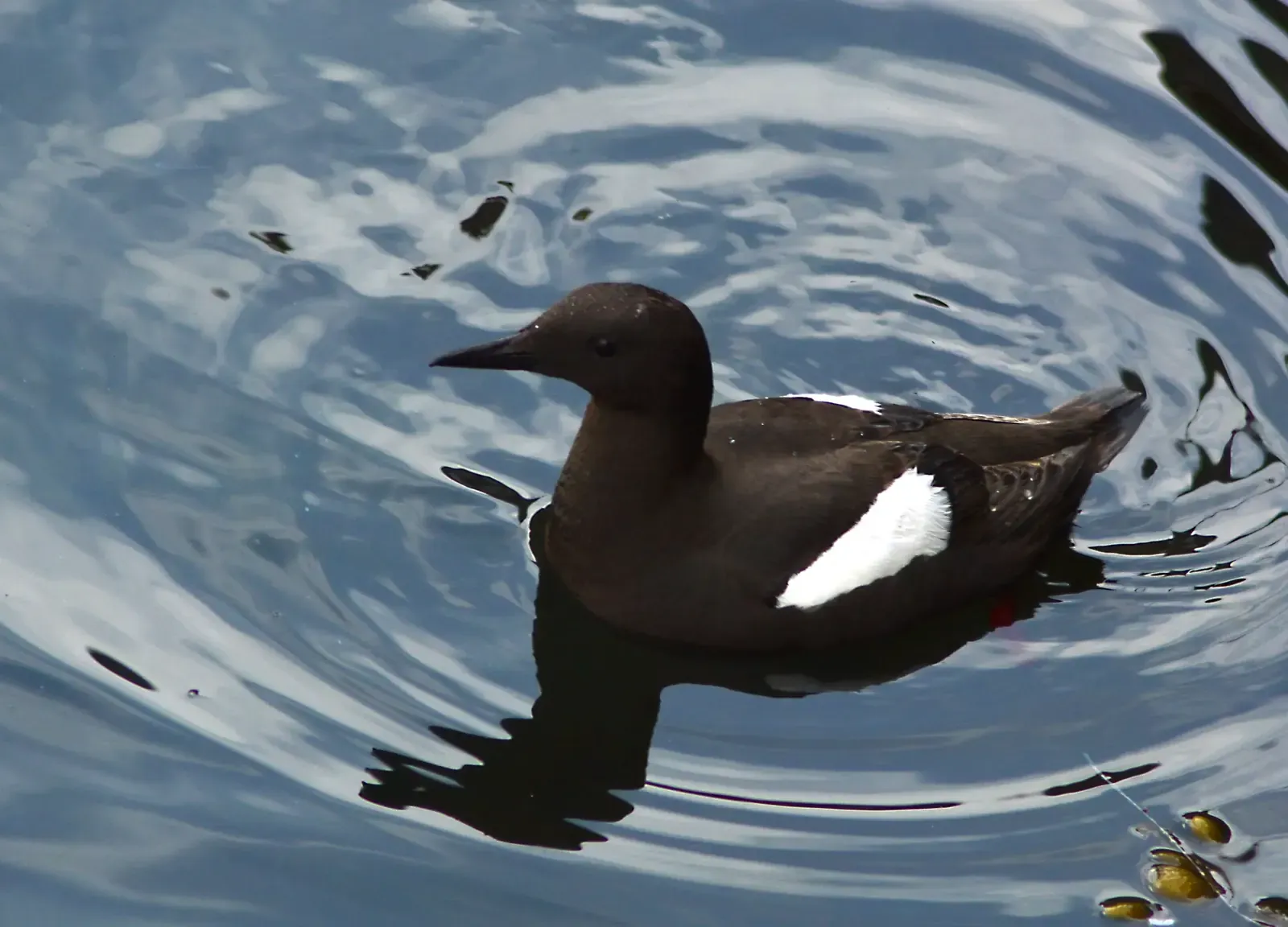
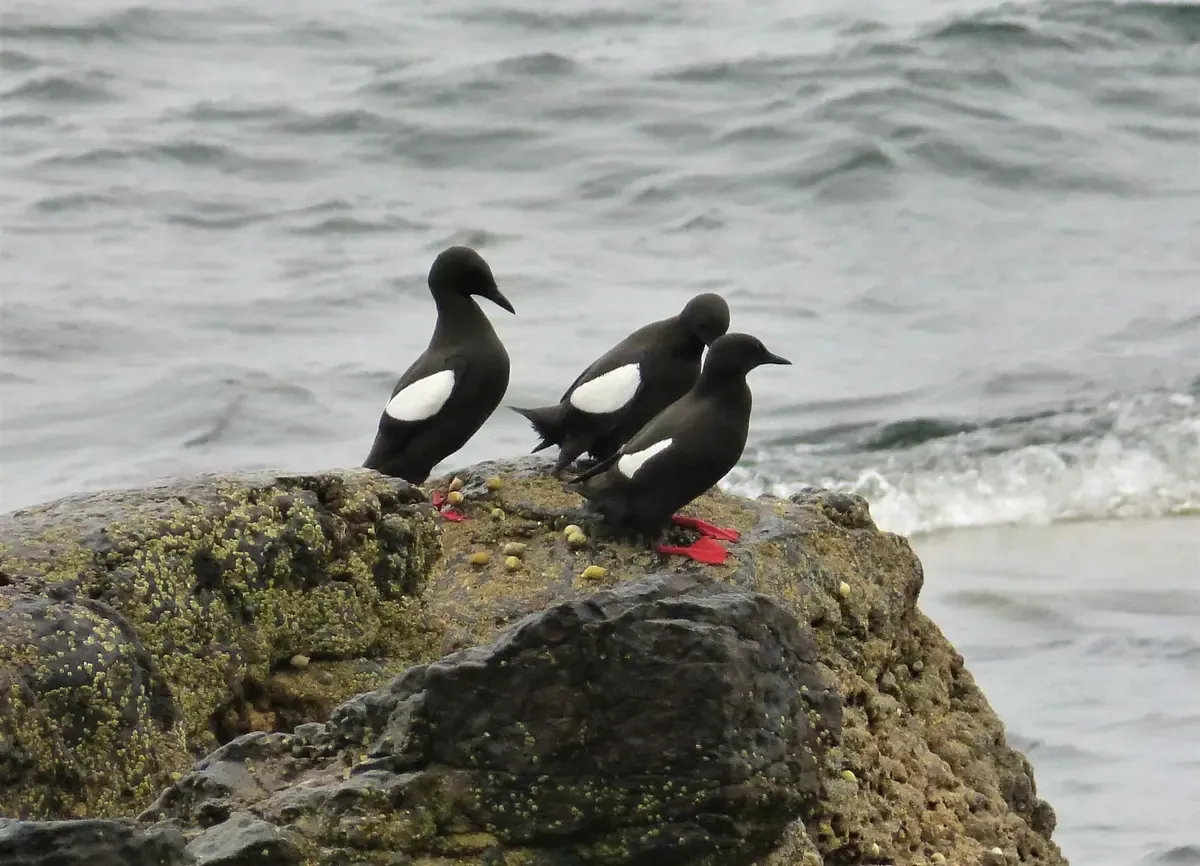
- In summer plumage all black with a large white wing patch and red legs
- In winter white head and underparts, barred upperparts, wings keep their colours
- Pointed black bill with a red gape, pear-shaped body and fairly small head
- Male and female look alike, young birds have a mottled white wing patch
Call and song
Displaying males give series of thin, piping "sipp-sipp-sipp", sometimes a sawing "sipp-sy-sipp-sy" and drawn-out "siiiiiyy". In the breeding season the call is a high whistle.
Where and when
It is a partial migrant that breeds in Sweden and is reported all year round. It breeds on the west coast from Bohuslän to northwest Skåne, on Gotland and from Östergötland north to the Finnish border. Baltic birds winter in the southern and central Baltic, west coast birds largely in the Kattegat in Danish waters. Its share of all bird reports is highest in Halland, Gotland and Kalmar.
When is it seen in Sweden?
Where is it reported?
- No reports
- Small share
- Medium share
- Large share
Reported all year round. Its share of all bird reports is highest in Halland, Gotland and Kalmar.
Food and behaviour
It eats mainly fish and crustaceans, and also molluscs, insects and plant material. The main prey is eelpout in the Baltic and butterfish on the west coast. It dives from the surface and swims underwater for food, often first dipping its head in up to above the eyes. It flies low over the water with fast, whirring wingbeats. It breeds in small colonies or as single pairs.
More auks
Photo: Jacob Spinks, CC BY 2.0, via Wikimedia Commons, resized

Photo: gailhampshire, CC BY 2.0, via Wikimedia Commons, resized

The text was written with AI from facts in Wikipedia and may be shared under CC BY-SA 4.0. Sources: Swedish article, English article, German article
Report data: Artportalen (SLU Swedish Species Information Centre) via GBIF.org, 2016 to 2025. Red list: The Swedish Red List 2025, SLU Swedish Species Information Centre via GBIF.org.
Checked against sources on . How we make these pages