Muscicapidae
European Robin
Erithacus rubecula
- Scientific name
- Erithacus rubecula
- Family
- Muscicapidae
- In Sweden
- Partial migrant, breeds here
- Size
- 12.5 to 14.0 cm
- Swedish Red List 2025
- Not red-listed
- Global Red List (IUCN)
- Least concern (LC)
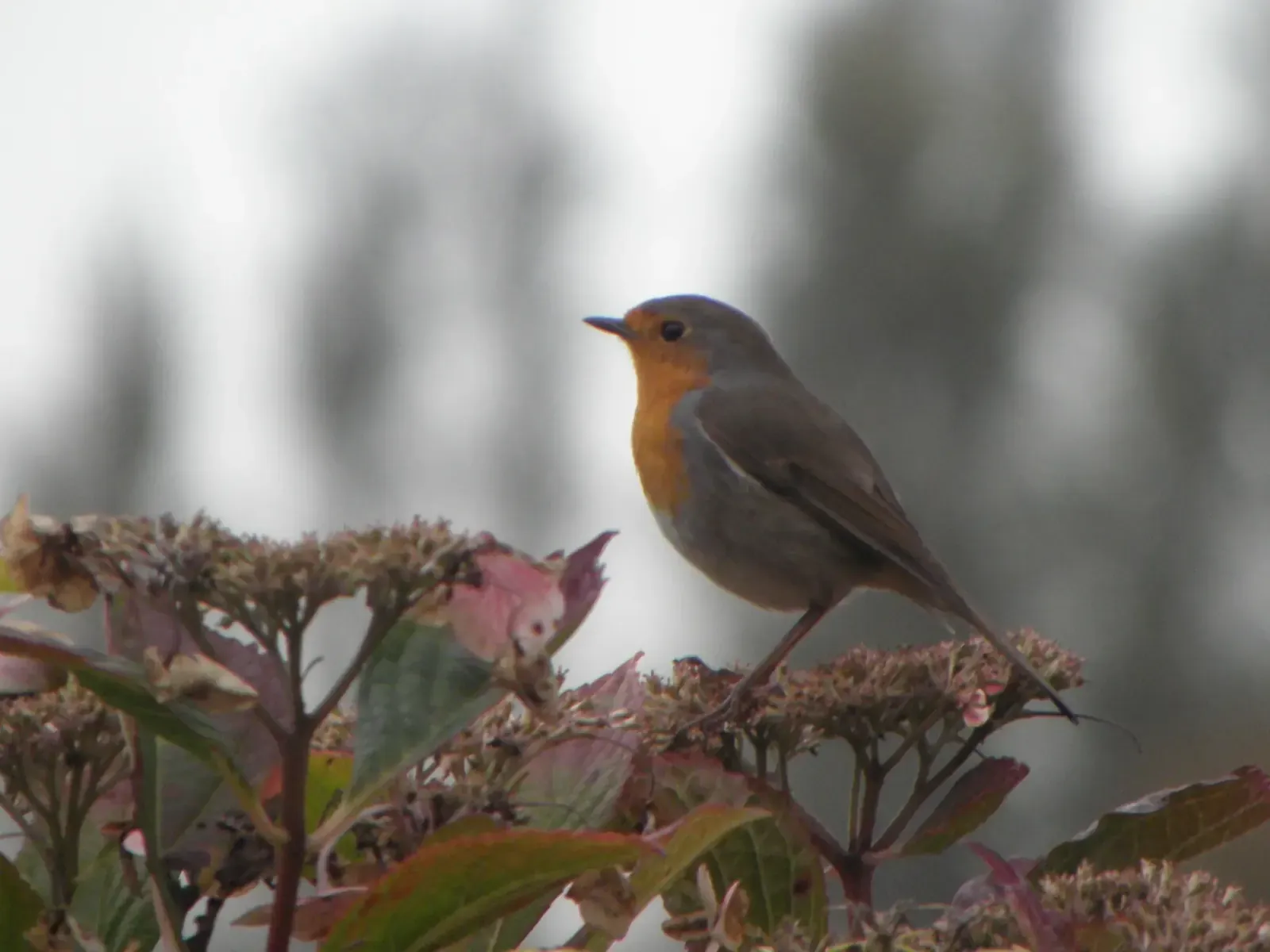
The European Robin is a small, round bird with a strong orange-red breast and face. It lives mainly in coniferous and mixed forest, in northern Europe preferably spruce forest, and also in parks and gardens.
How to recognise it
- Strong orange-red breast and face, edged with bluish grey on the sides of neck and breast
- Brownish upperparts, grey to brownish flanks and greyish-white belly
- Small and round with a big-looking head, black pointed bill and fairly long dark brown legs
- Sexes alike, young birds are brown with yellow spotting and no red breast
Call and song
The song is a rippling cascade of clear notes with changes of tempo, often starting with a high, sustained note. The call is a clicking tick, drawn out into long series, tick-ick-ick-ick, by an anxious bird. The alarm call is often likened to a longcase clock being wound. Both sexes sing during the winter half of the year.
Where and when
The European Robin is a partial migrant that breeds in most of Sweden except the mountains. It arrives in late March or early April and leaves in September to November, migrating at night. A few individuals winter in southern Sweden. With an estimated three to six million pairs it is one of the country's commonest birds. It is reported all year round and from all 21 counties.
When is it seen in Sweden?
Where is it reported?
- No reports
- Small share
- Medium share
- Large share
Reported all year round. Reported from all 21 counties.
Food and behaviour
It feeds on spiders, worms and insects, and in autumn and winter also berries and fruit. It often hops fearlessly on the ground in front of people and animals to catch insects they disturb. Males are known for very aggressive territorial behaviour. The nest lies hidden on the ground in a hollow or between tree roots, and the female incubates the eggs for 13 to 15 days.

Easily confused with
-
Luscinia megarhynchos
The European Robin often sings in the evening and sometimes into the night, so it is sometimes mistaken for the Common Nightingale.
More songbirds




Photo: Rob Hille, public domain, via Wikimedia Commons, resized

Photo: TRinaud, CC BY 4.0, via Wikimedia Commons, resized

The text was written with AI from facts in Wikipedia and may be shared under CC BY-SA 4.0. Sources: Swedish article, English article, German article
Report data: Artportalen (SLU Swedish Species Information Centre) via GBIF.org, 2016 to 2025. Red list: The Swedish Red List 2025, SLU Swedish Species Information Centre via GBIF.org.
Checked against sources on . How we make these pages