Turdidae
Fieldfare
Turdus pilaris
- Scientific name
- Turdus pilaris
- Family
- Turdidae
- In Sweden
- Partial migrant, breeds here
- Size
- 22 to 27 cm
- Swedish Red List 2025
- Near threatened (NT)
- Global Red List (IUCN)
- Least concern (LC)
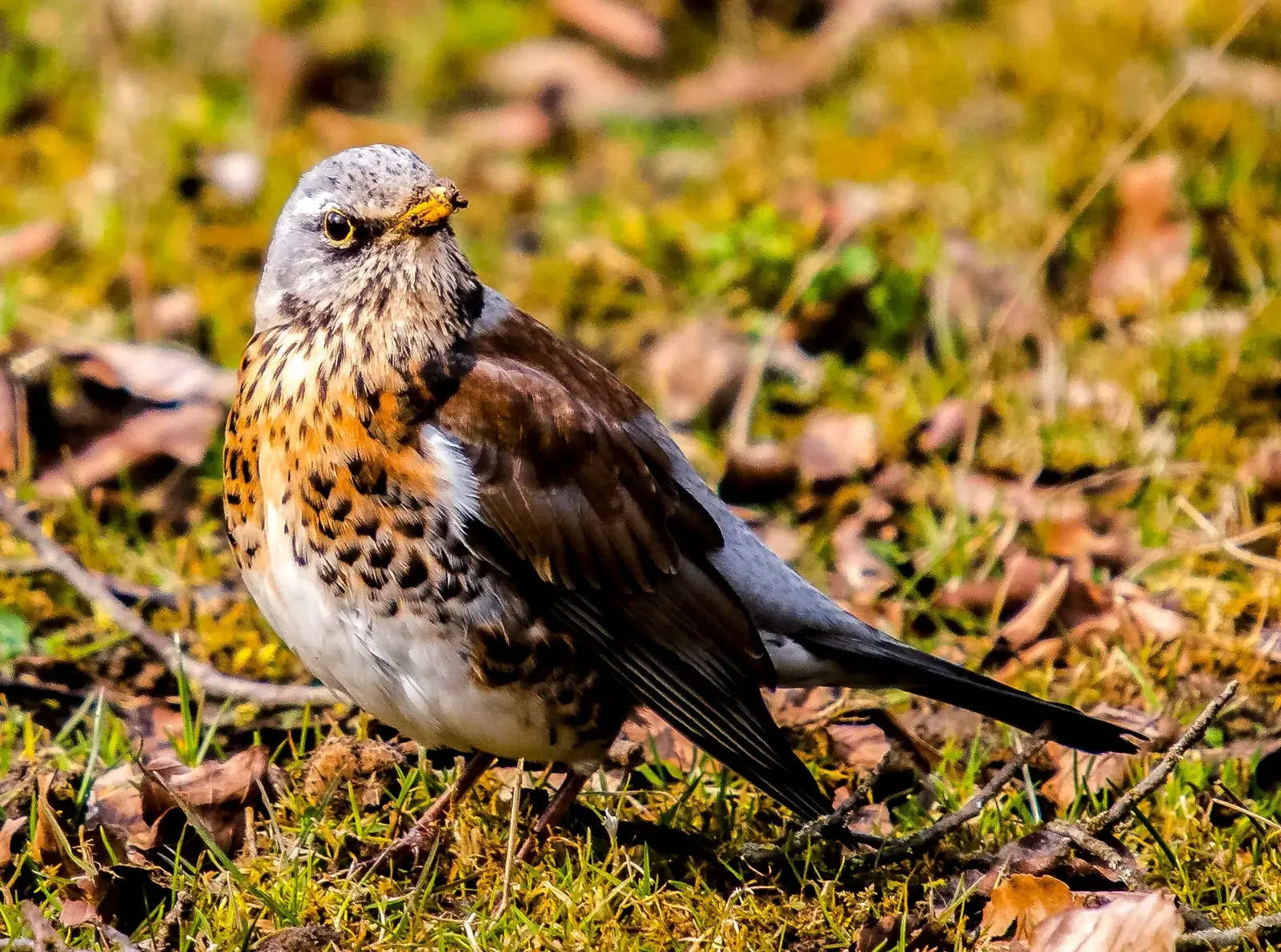
The Fieldfare is a long-tailed, heavily built thrush that breeds in large numbers all over Sweden. It breeds in woodland, parks and gardens, and in winter flocks are found in open country and on farmland.
How to recognise it
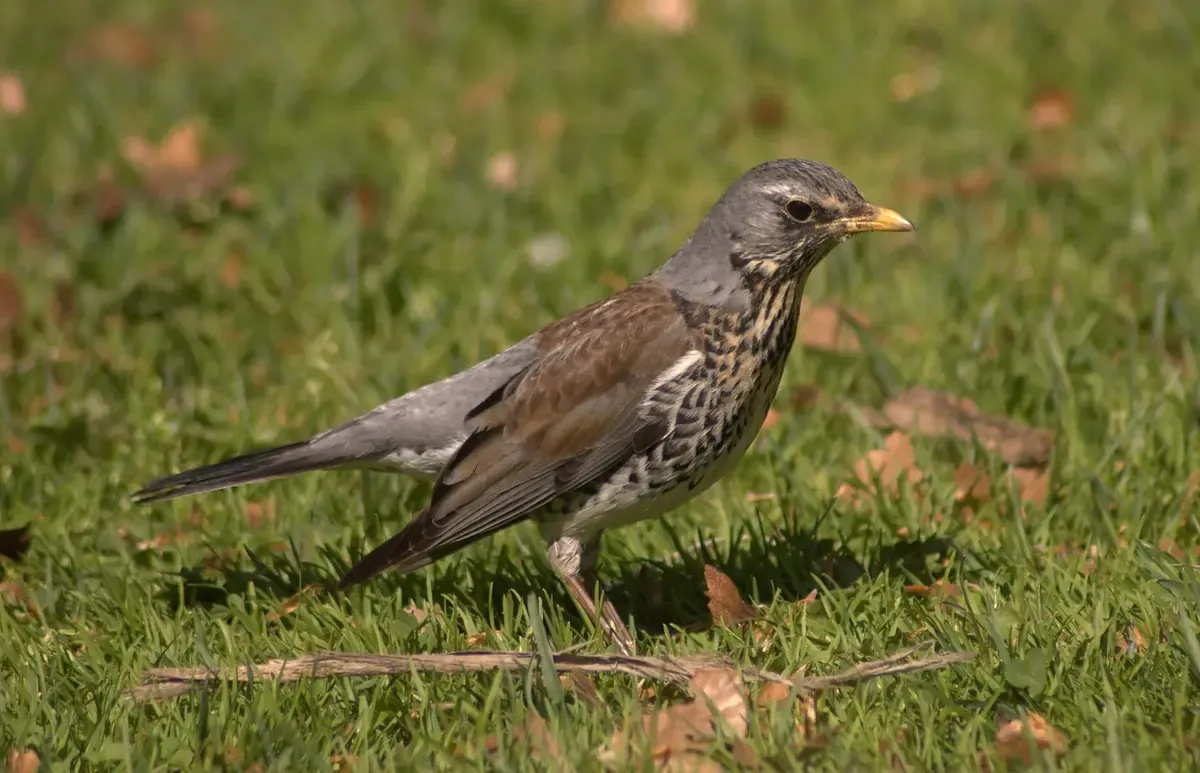
- Ash-grey crown, nape and rump against chestnut-brown shoulders and upper back
- Orange-buff breast with dark streaks, white belly and black arrowhead spots on the flanks
- Yellow-orange bill with a grey tip, pale eyebrow and dark between eye and bill
- White underwing coverts show clearly in flight, sexes alike but female slightly browner
Call and song
The commonest call is a harsh, repeated chattering ”schäck”. In flight it gives a repeated ”tjack” for a few seconds and a thin, high ”giih”. The male's song is weak and not very melodic, and is often given in flight during the breeding season.
Where and when
The Fieldfare is a partial migrant that breeds in large numbers all over Sweden, though roughly speaking birds breeding north of Mora move south for the winter. It is reported from all 21 counties and most in December and January. The population was estimated at 594 000 pairs in 2018, but the species has declined and is red-listed as Near Threatened (NT).
When is it seen in Sweden?
Where is it reported?
- No reports
- Small share
- Medium share
- Large share
Reported most in December and January. Reported from all 21 counties.
Food and behaviour
It usually breeds in small colonies and defends the nest aggressively by dropping droppings on predators. It readily uses its chatter to warn of tawny owls, cats and other dangers. Migrating and wintering birds often form large flocks, often together with Redwings.
More in the Turdidae family
Photo: Kathy Büscher, CC BY 2.0, via Wikimedia Commons, resized

Photo: Martin Olsson, CC BY-SA 3.0, via Wikimedia Commons, resized

The text was written with AI from facts in Wikipedia and may be shared under CC BY-SA 4.0. Sources: Swedish article, English article, German article
Report data: Artportalen (SLU Swedish Species Information Centre) via GBIF.org, 2016 to 2025. Red list: The Swedish Red List 2025, SLU Swedish Species Information Centre via GBIF.org.
Checked against sources on . How we make these pages