Accipitridae
White-tailed Eagle
Haliaeetus albicilla
- Scientific name
- Haliaeetus albicilla
- Family
- Accipitridae
- In Sweden
- Partial migrant, breeds here
- Size
- 76 to 94 cm
- Swedish Red List 2025
- Not red-listed
- Global Red List (IUCN)
- Least concern (LC)
The White-tailed Eagle, with a wingspan of 190 to 240 cm, lives most of the year near large open waters such as coasts, lakes, wetlands and rivers. In Sweden it breeds mainly along the Baltic coast and at freshwater lakes across the country.
How to recognise it
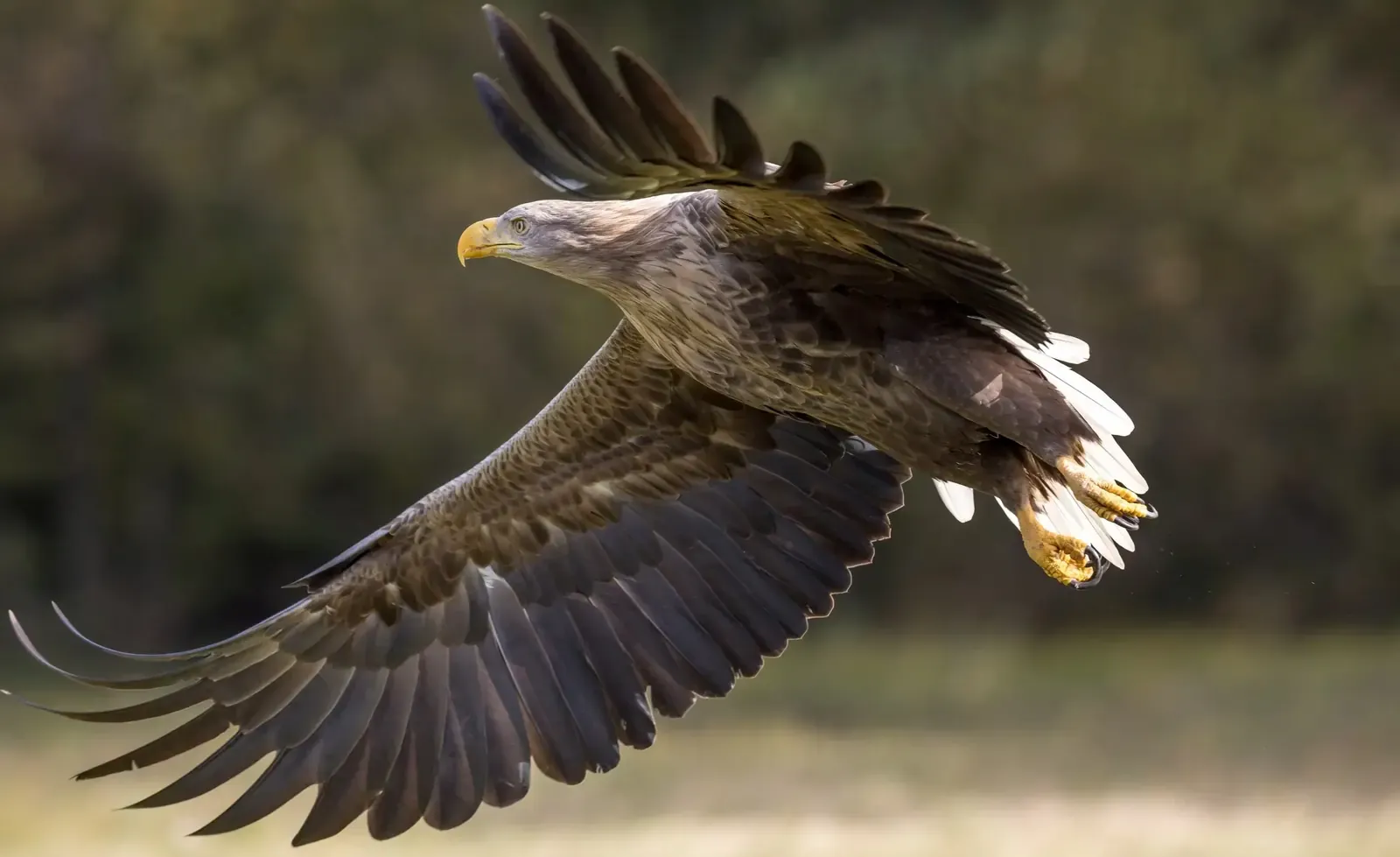
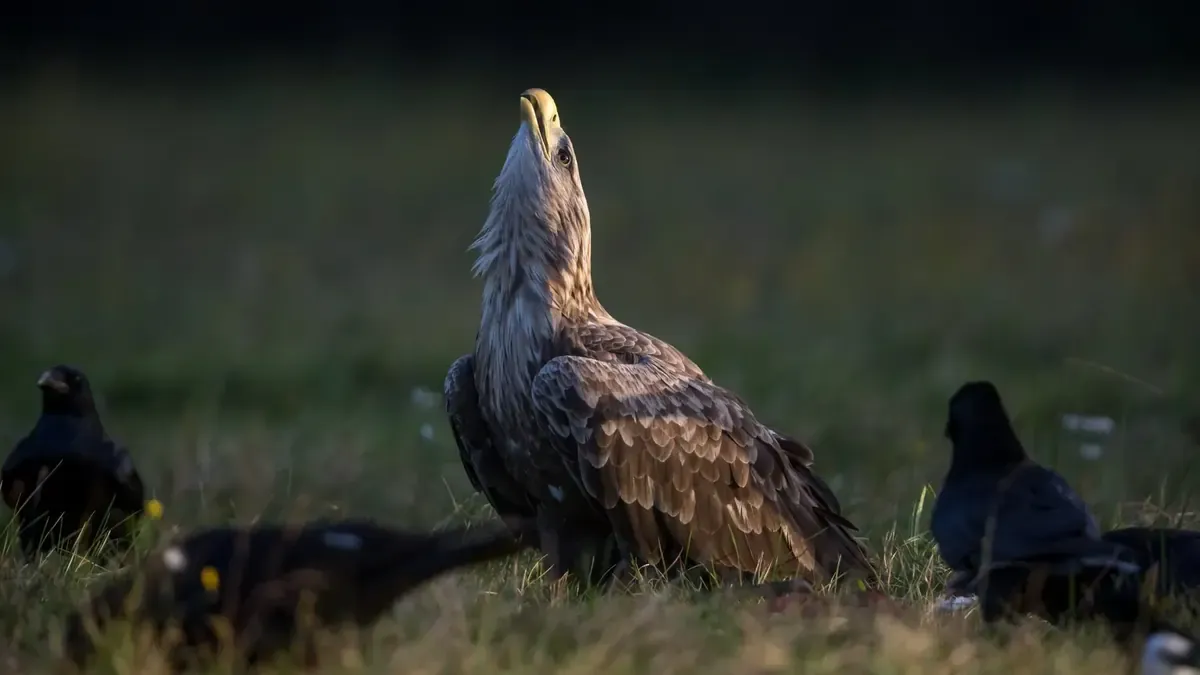
- Adults are evenly brown with a pale brown head and a short, wedge-shaped white tail
- Very heavy yellow bill, and adults also have yellow cere, feet and eyes
- Broad wings with straight edges, a squared-off tip and spread, very long flight feathers
- Young birds are dark brown without a white tail, with dark grey feet and cere
Call and song
The White-tailed Eagle is quiet except in the breeding season, when it gives a cackling, shrill series that recalls the call of a Black Woodpecker. The calling is heard almost only near the nest, mainly at dawn and dusk. The alarm call is a deep, hard "kleck".
Where and when
The White-tailed Eagle is a partial migrant that breeds in Sweden, mainly along the Baltic coast and at freshwater lakes across the country. In winter Swedish birds may move south to central Europe, move shorter distances or stay in the breeding area. The population was estimated in 2025 at about 2 800 reproductive individuals. It is reported from all 21 counties and most often from November to February.
When is it seen in Sweden?
Where is it reported?
- No reports
- Small share
- Medium share
- Large share
Reported most in November to February. Reported from all 21 counties.
Food and behaviour
It feeds mainly on fish, often pike and bream, as well as waterbirds, small mammals and carrion. It often steals food from other animals and birds. If it grabs a fish that is too big, it can swim ashore with the catch by paddling with its wings. It spends much of the day sitting in trees or on cliffs, often still for hours, and in winter eagles gather in groups.
Easily confused with
-
Aquila chrysaetos
In flight it differs from the Golden Eagle by broad wings, a short tail and a long protruding head. Its legs are not feathered to the toes, and young birds lack pale wing patches.
More birds of prey
Photo: Andreas Weith, CC BY-SA 4.0, via Wikimedia Commons, resized

Photo: Andreas Weith, CC BY-SA 4.0, via Wikimedia Commons, resized

The text was written with AI from facts in Wikipedia and may be shared under CC BY-SA 4.0. Sources: Swedish article, English article, German article
Report data: Artportalen (SLU Swedish Species Information Centre) via GBIF.org, 2016 to 2025. Red list: The Swedish Red List 2025, SLU Swedish Species Information Centre via GBIF.org.
Checked against sources on . How we make these pages