Picidae
Black Woodpecker
Dryocopus martius
- Scientific name
- Dryocopus martius
- Family
- Picidae
- In Sweden
- Resident all year
- Size
- 40 to 57 cm
- Swedish Red List 2025
- Not red-listed
- Global Red List (IUCN)
- Least concern (LC)
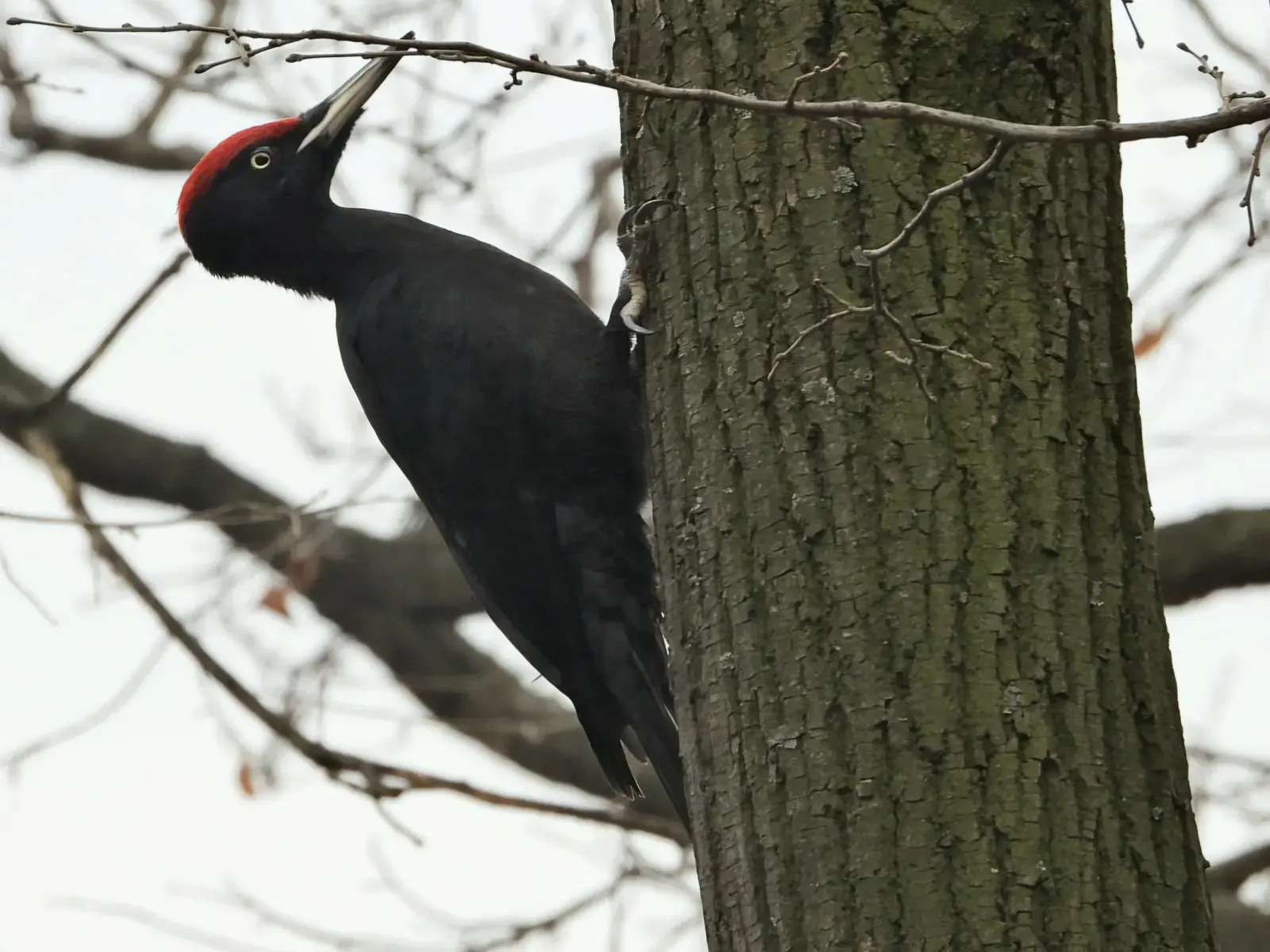
The Black Woodpecker is Europe's largest woodpecker, almost entirely black and 40 to 57 cm long. It breeds in forest and occurs throughout Sweden except in the mountains.
How to recognise it
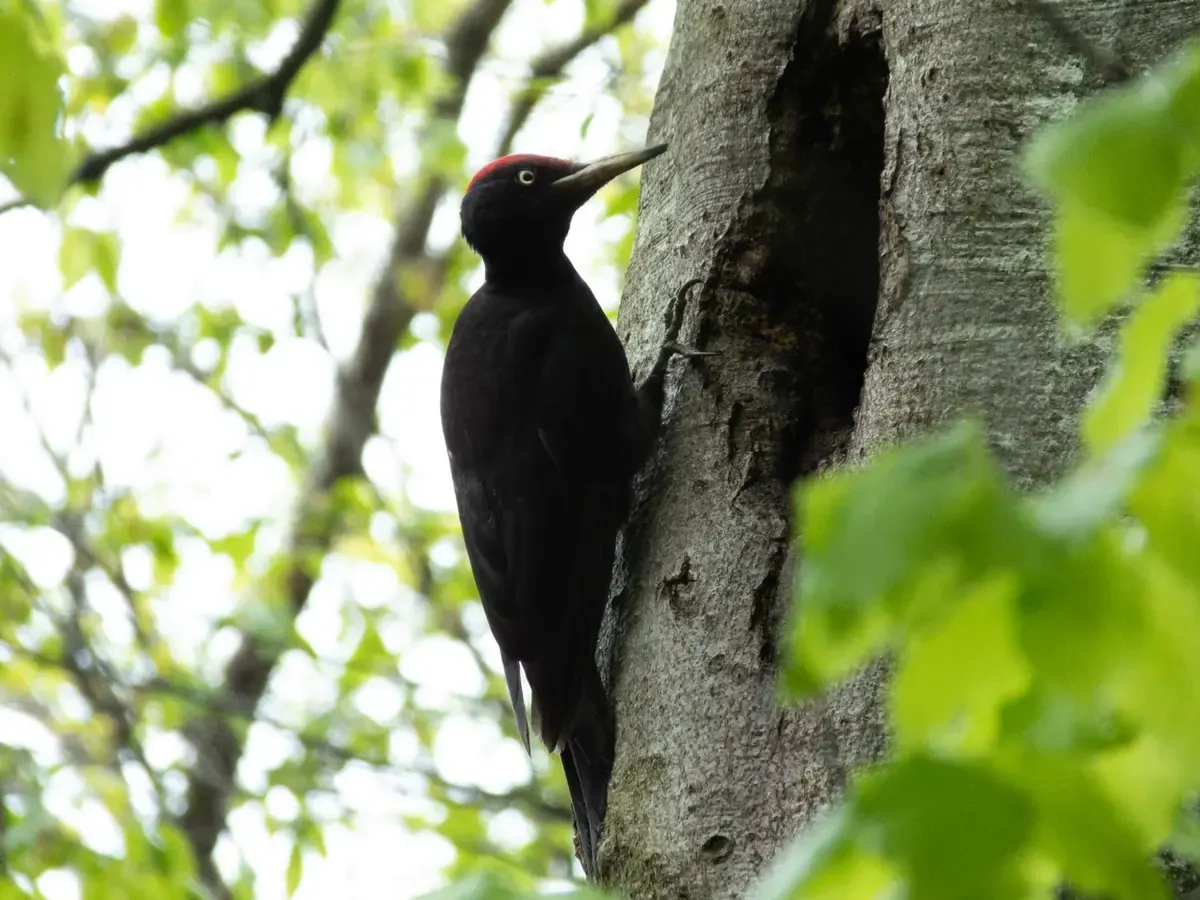
- Almost entirely black plumage with pale eyes and a fairly long neck
- Strong, bone-white bill, broad at the base with a clear dark grey tip
- Almost as big as a Rook but slimmer, with a much longer tail
- Male has a red forehead and crown, female is red only on the nape
Call and song
The song is heard in spring and is a loud, shrill klyi-klyi-klyi in quick succession. In flight it gives a harsh, persistent kryck-kryck-kryck or krri-krri-krri with a rolling r. After landing a loud, whistling, drawn-out kliiyy is often heard. The spring drumming is powerful and rolling and can be heard up to four kilometres away.
Where and when
The Black Woodpecker is resident and occurs sparsely, locally fairly commonly, throughout Sweden except in the mountains. It is reported all year round and from all 21 counties. It breeds in coniferous, mixed and deciduous forest but is commonest in mixed forest, preferring tall, pine-dominated old forest. From 2025 its Swedish threat status changed from near threatened to least concern.
When is it seen in Sweden?
Where is it reported?
- No reports
- Small share
- Medium share
- Large share
Reported all year round. Reported from all 21 counties.
Food and behaviour
It feeds mostly on ants, especially carpenter ants, which it digs out of infested trees, stumps and fallen trunks. In winter it also opens anthills, and in late summer it may eat cherries and bilberries. Its flight is straight and looks unsteady with flapping wings, not undulating like other woodpeckers. The nest hole is dug about ten metres above the ground, usually in a fairly isolated aspen or pine.
More in the Picidae family
Photo: Иван Везенковић, CC BY-SA 4.0, via Wikimedia Commons, resized

Photo: Julianruizp, CC BY-SA 4.0, via Wikimedia Commons, resized

The text was written with AI from facts in Wikipedia and may be shared under CC BY-SA 4.0. Sources: Swedish article, English article, German article
Report data: Artportalen (SLU Swedish Species Information Centre) via GBIF.org, 2016 to 2025. Red list: The Swedish Red List 2025, SLU Swedish Species Information Centre via GBIF.org.
Checked against sources on . How we make these pages