Fringillidae
Brambling
Fringilla montifringilla
- Scientific name
- Fringilla montifringilla
- Family
- Fringillidae
- In Sweden
- Partial migrant, breeds here
- Size
- 14 to 16 cm
- Swedish Red List 2025
- Not red-listed
- Global Red List (IUCN)
- Least concern (LC)
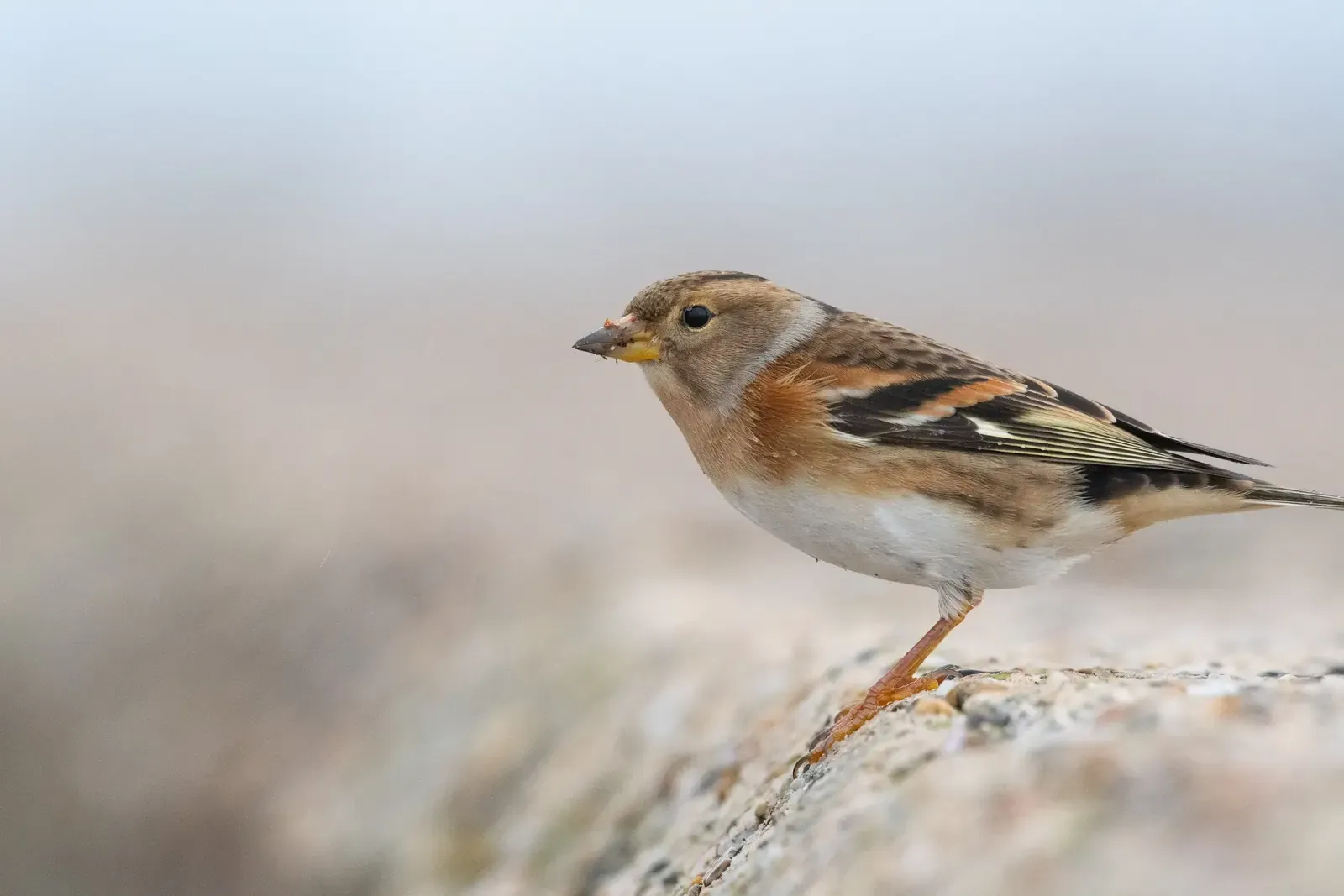
The Brambling is a finch that breeds in coniferous, birch and mixed forest, in Sweden mainly in the forests and mountains of Norrland. In winter it is a fairly common visitor to bird feeders.
How to recognise it
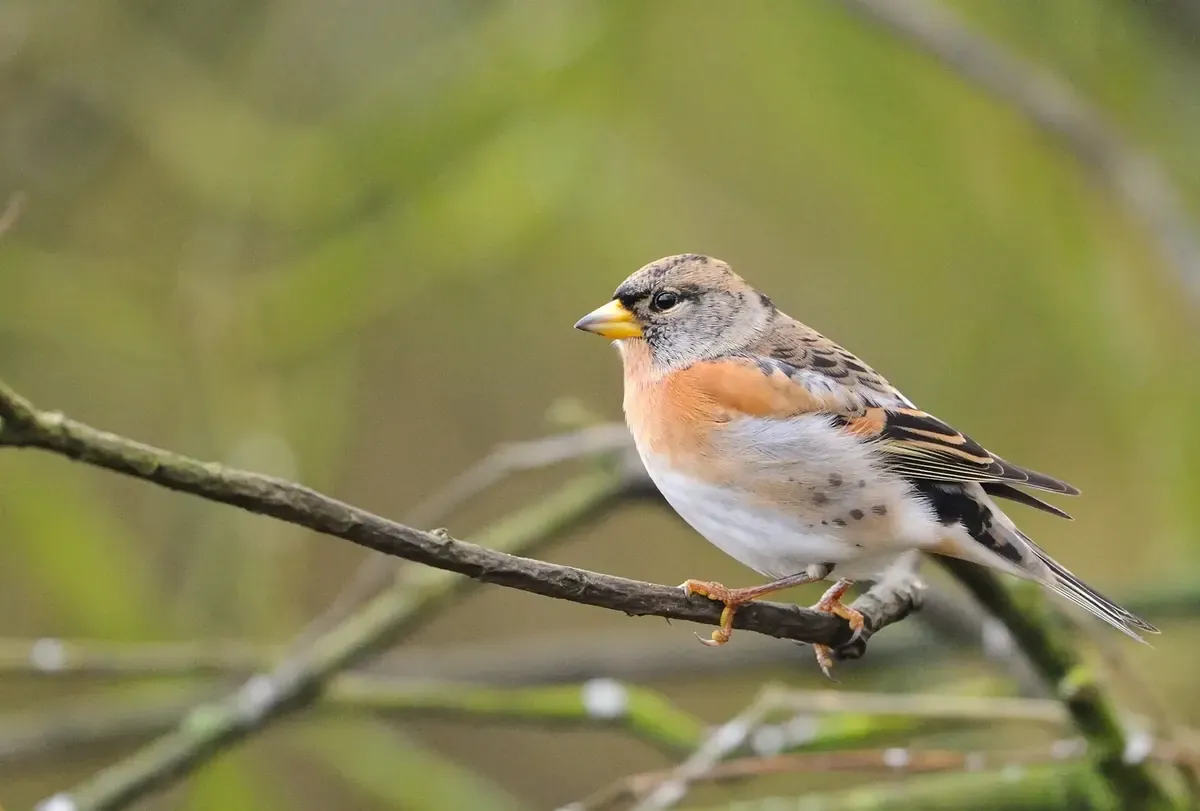
- White rump and a more or less orange breast in all plumages
- Lacks the white outer tail feathers of the Chaffinch
- Summer male has a glossy blue-black head, nape and mantle and a black bill
- Female has a grey and brown head, orange-buff breast and warm brown mantle
Call and song
The song is a monotonous, desolate buzzing tone a second long, which the ornithologist Erik Rosenberg likened to a small circular saw in the distance. The call is loud and characteristic, with a nasal, croaking quality. In flight it gives short calls written tk-tk.
Where and when
The Brambling is a partial migrant that breeds in Sweden, mainly in the forests and mountains of Norrland, from May to early August. It normally winters in Central Europe, but when food is plentiful large numbers stay in Sweden, and in beechmast years several million may winter there. It is reported most in October and December. Its share of all bird reports is highest in Norrbotten, Jämtland and Västerbotten.
When is it seen in Sweden?
Where is it reported?
- No reports
- Small share
- Medium share
- Large share
Reported most in October and December. Its share of all bird reports is highest in Norrbotten, Jämtland and Västerbotten.
Food and behaviour
It feeds mainly on seeds and berries, but the young are fed insects, especially caterpillars. In its winter quarters it specialises in beechmast and keeps mainly to broadleaved woodland, especially with beech or hornbeam. On spring and autumn migration large flocks move in a curious rolling way over stubble and other fields, often together with Chaffinches.
More in the Fringillidae family
Photo: TRinaud, CC BY 4.0, via Wikimedia Commons, resized

Photo: Kev Chapman, CC BY 2.0, via Wikimedia Commons, resized

The text was written with AI from facts in Wikipedia and may be shared under CC BY-SA 4.0. Sources: Swedish article, English article, German article
Report data: Artportalen (SLU Swedish Species Information Centre) via GBIF.org, 2016 to 2025. Red list: The Swedish Red List 2025, SLU Swedish Species Information Centre via GBIF.org.
Checked against sources on . How we make these pages