Sturnidae
Common Starling
Sturnus vulgaris
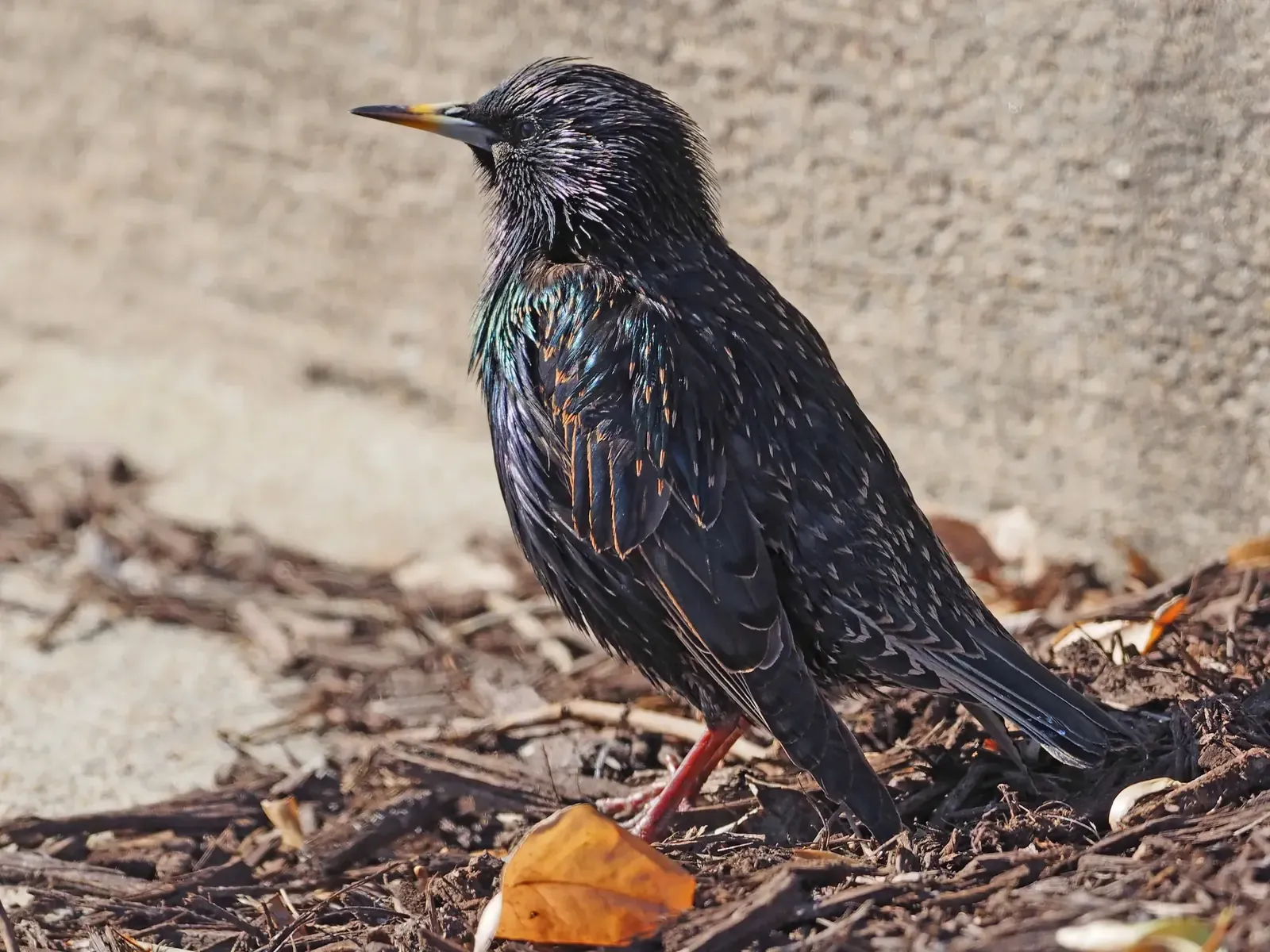
- Scientific name
- Sturnus vulgaris
- Family
- Sturnidae
- In Sweden
- Partial migrant, breeds here
- Size
- 19 to 22 cm
- Swedish Red List 2025
- Vulnerable (VU)
- Global Red List (IUCN)
- Least concern (LC)
The Common Starling is a songbird of the starling family that breeds in Sweden and is partly migratory. It is often seen feeding on short grass such as farmland, pastures, sports fields and golf courses.
How to recognise it
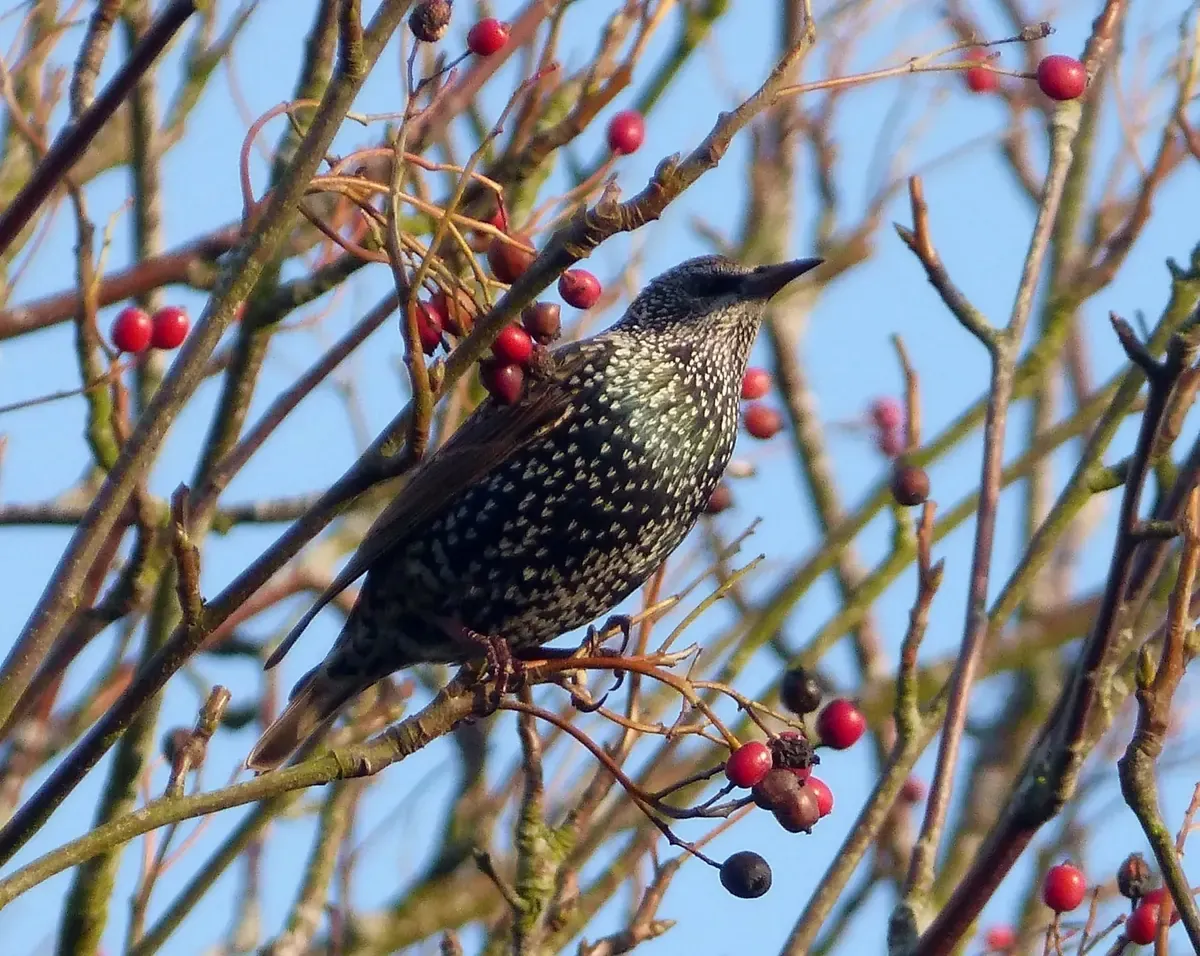
- Blackish with green or purple metallic gloss, in winter with white to buff feather tips
- Yellow bill in breeding plumage, blackish bill in winter plumage
- Short tail and triangular, pointed wings in flight
- Male has a dark brown iris and female a pale one, juveniles are grey-brown without gloss
Call and song
The song is sustained and chattering, with rising and falling piping notes, smacking, whistling and rattling sounds and mimicry, often of quail, buzzard and lapwing. It warns of flying predators with a rapidly repeated, sharp “spett, spett” and of ground predators with a drawn-out “brrrrrrrt” or “tschrrr”. A flying flock's whooshing wingbeats carry hundreds of metres.
Where and when
It breeds in Sweden and is partly migratory, and is reported from all 21 counties, most in March. Return migration starts in February, and in July starlings in southern Scandinavia already move to Germany and Denmark. It is densest where groups of trees with holes border meadows. It is red-listed as Vulnerable (VU), with just over 400 000 pairs estimated in 2018.
When is it seen in Sweden?
Where is it reported?
- No reports
- Small share
- Medium share
- Large share
Reported most in March. Reported from all 21 counties.
Food and behaviour
In spring and early summer it mainly eats insects, larvae, earthworms and small snails, the rest of the year mostly fruit and berries. On the ground it walks rather than hops. Starlings roost together, mainly in large reedbeds, and also in groves, dense thickets and town centres. The nest is mainly placed in tree holes, though nest boxes and cavities in buildings are used too.
Easily confused with
-
Sturnus unicolor
The closely related Spotless Starling differs from the Common Starling by lacking pale feather tips in adult breeding plumage.
More songbirds
Photo: Judy Gallagher, CC BY 2.0, via Wikimedia Commons, resized

Photo: gailhampshire, CC BY 2.0, via Wikimedia Commons, resized

The text was written with AI from facts in Wikipedia and may be shared under CC BY-SA 4.0. Sources: Swedish article, English article, German article
Report data: Artportalen (SLU Swedish Species Information Centre) via GBIF.org, 2016 to 2025. Red list: The Swedish Red List 2025, SLU Swedish Species Information Centre via GBIF.org.
Checked against sources on . How we make these pages