Fringillidae
Red Crossbill
Loxia curvirostra
- Scientific name
- Loxia curvirostra
- Family
- Fringillidae
- Size
- 15 to 17 cm
- Swedish Red List 2025
- Not red-listed
- Global Red List (IUCN)
- Least concern (LC)
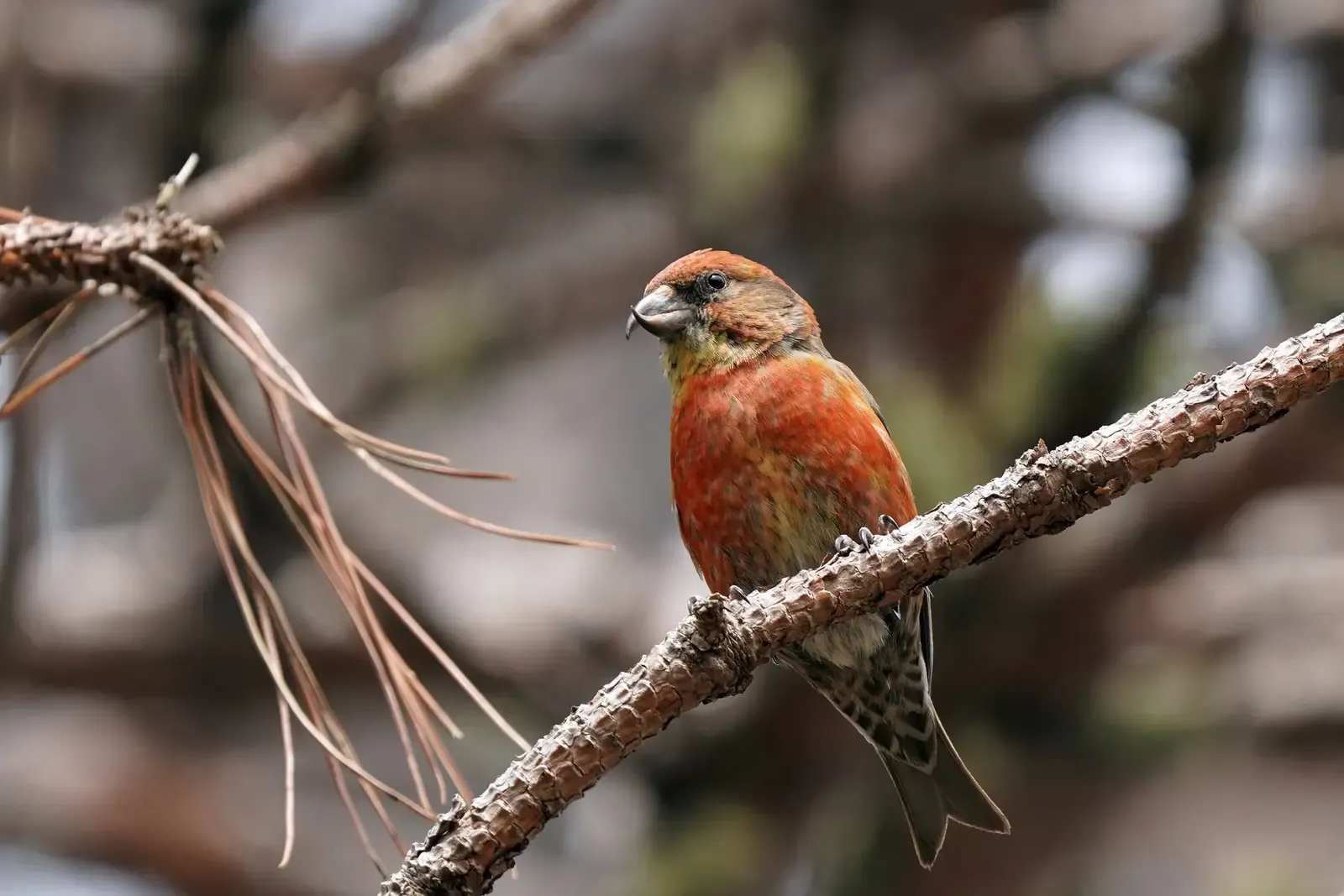
The Red Crossbill is a finch with crossed bill tips, adapted for picking seeds out of cones. It breeds in conifer forest and in Europe is typical of spruce and fir woods.
How to recognise it
- Crossed bill tips and a thick, curved bill
- Compact, with a heavy round head and a short, deeply forked tail
- Male from two years old orange to brick-red, female grey-green to yellow-green, juvenile streaky grey-brown
- In flight it shows dark wings with no wing bars
Call and song
The contact call is a hard "gip gip gip" or "klip-klip-klip", often heard in flight. The varied song mixes elements like the flight call with nasal sounds and hard buzzing notes, and has some likeness to the song of the Greenfinch.
Where and when
The Red Crossbill is reported most in January, February, October and November. Its share of all bird reports is highest in Västerbotten, Jämtland and Dalarna. It belongs in conifer forest but can also turn up in mixed woodland, parks and large gardens with a few conifers. It is the provincial bird of Medelpad.
When is it seen in Sweden?
Where is it reported?
- No reports
- Small share
- Medium share
- Large share
Reported most in January, February, October and November. Its share of all bird reports is highest in Västerbotten, Jämtland and Dalarna.
Food and behaviour
Most feed mainly on spruce seeds, but some populations specialise in pine cones or larch. It also eats seeds from fruits such as rowan berries, and insects like caterpillars. When feeding it is completely silent and climbs about the branches using its bill. Outside the breeding season it forms flocks, often with other crossbill species, and it does not migrate but makes wandering movements.
Easily confused with
-
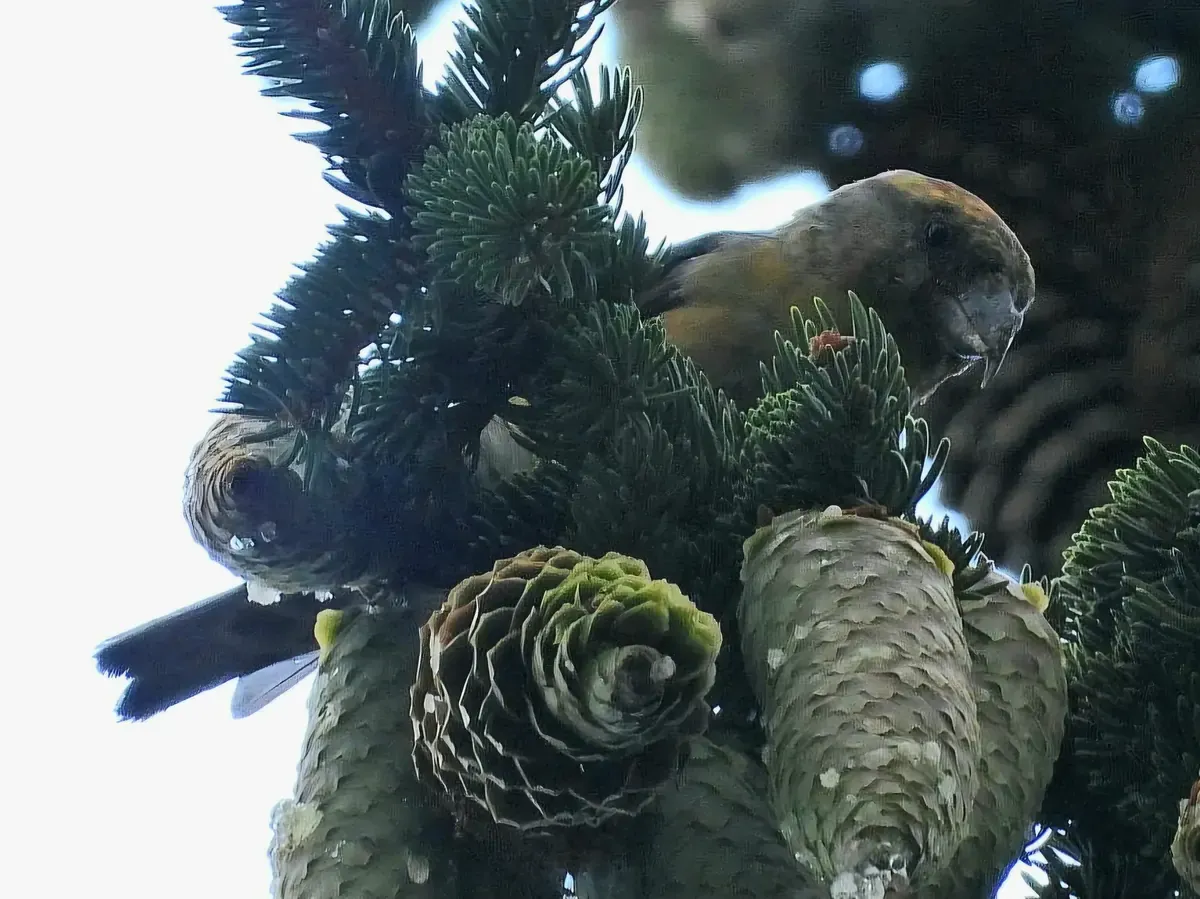
The Red Crossbill has a proportionally smaller head, thinner neck and smaller bill than the Parrot Crossbill. Its bill is longer than it is deep, while the Parrot Crossbill's bill is the reverse.
More in the Fringillidae family
Photo: USFWS Midwest Region, public domain, via Wikimedia Commons, resized

Photo: Иван Везенковић, CC BY-SA 4.0, via Wikimedia Commons, resized

The text was written with AI from facts in Wikipedia and may be shared under CC BY-SA 4.0. Sources: Swedish article, English article, German article
Report data: Artportalen (SLU Swedish Species Information Centre) via GBIF.org, 2016 to 2025. Red list: The Swedish Red List 2025, SLU Swedish Species Information Centre via GBIF.org.
Checked against sources on . How we make these pages