Strigidae
Long-eared Owl
Asio otus
- Scientific name
- Asio otus
- Family
- Strigidae
- In Sweden
- Partial migrant, breeds here
- Size
- 31 to 37 cm
- Swedish Red List 2025
- Endangered (EN)
- Global Red List (IUCN)
- Least concern (LC)
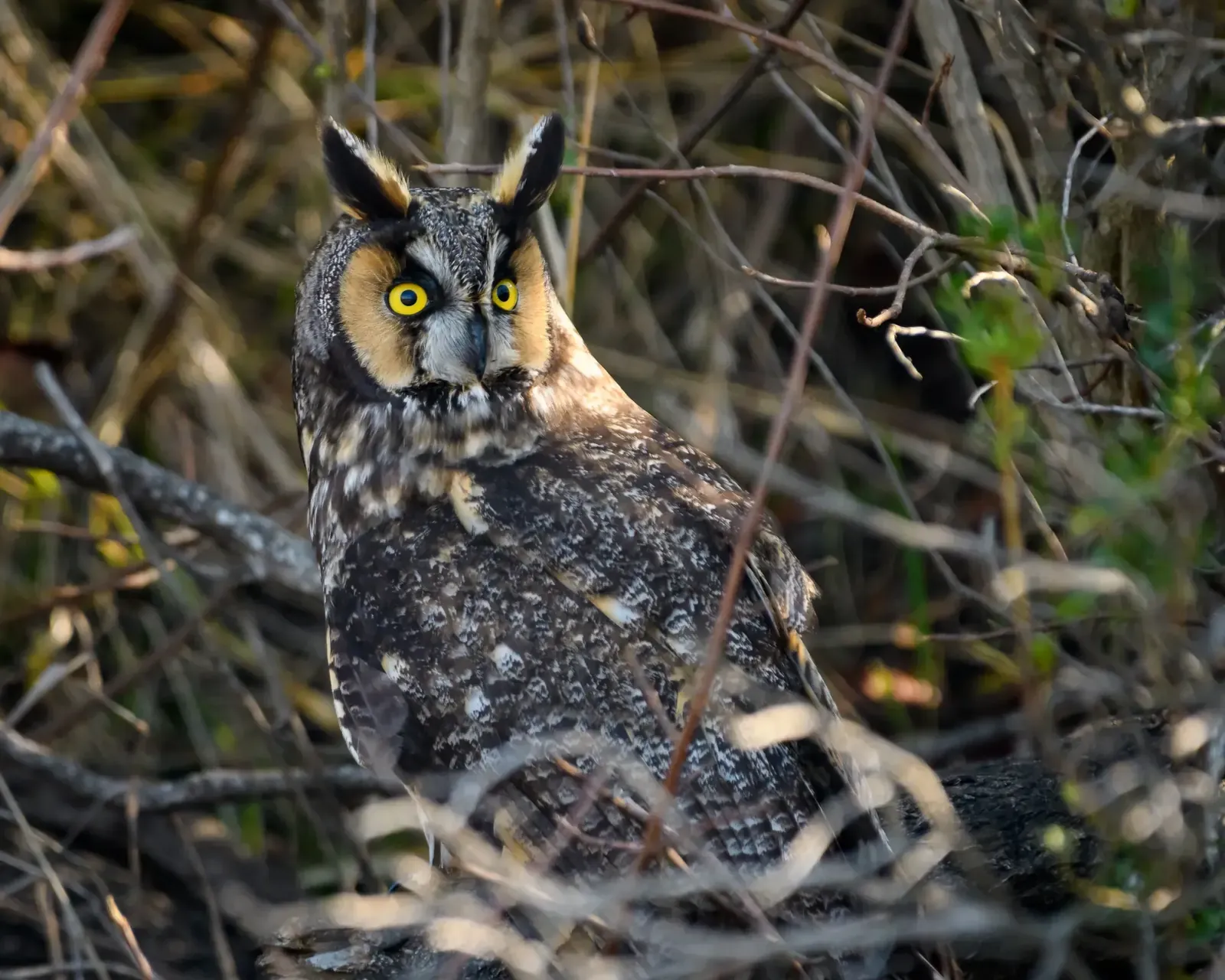
The Long-eared Owl is a medium-sized, nocturnal owl with long ear tufts. It breeds in Sweden and favours open country with woods or copses, but can also turn up in churchyards, parks and gardens.
How to recognise it
- Long ear tufts that can be raised and pointed upwards
- Glowing orange iris
- Rusty yellow and white underparts with blackish brown streaks, mottled upperparts
- Female larger and darker than male, young birds show a black facial mask
Call and song
The male's song is a deep "oh" repeated every 2.5 seconds. The female gives a weak, nasal "peh-äv". The young beg with a plaintive, two-syllable "pii-eh" that can be heard over a kilometre away. During courtship the male flies around striking its wings together, making a clapping sound.
Where and when
It breeds in Sweden and is fairly common in the south and centre, up to about 62° north. Most birds move south in autumn, but some winter in southern Sweden, mainly in Skåne. It is reported from all 21 counties, most in June and rarely in August and September. It is Endangered (EN) on the 2025 Red List, and numbers have more than halved over the last 15 years.
When is it seen in Sweden?
Where is it reported?
- No reports
- Small share
- Medium share
- Large share
Reported most in June. Rarely reported in August and September. Reported from all 21 counties.
Food and behaviour
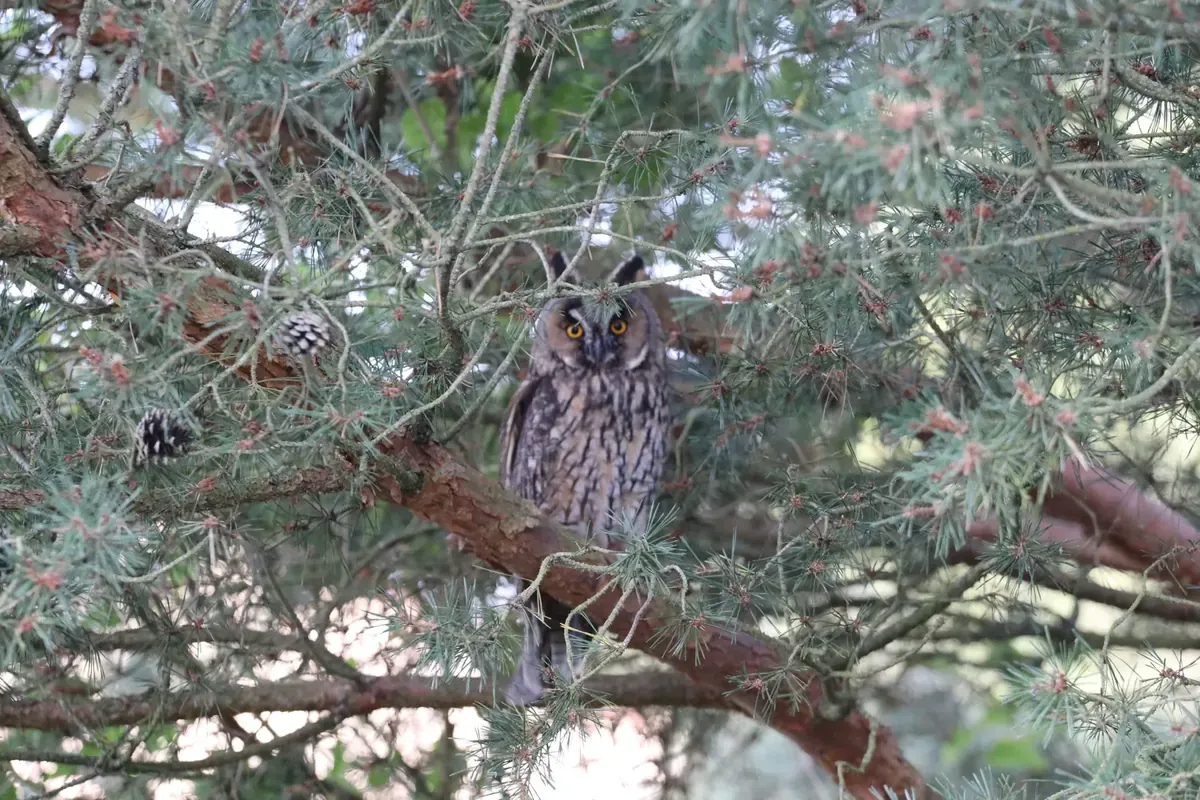
It is nocturnal and feeds mainly on small mammals such as voles, as well as insects. By day it sits camouflaged on a branch close to the trunk, drawing itself in so it looks very slim and elongated. Outside the breeding season 6 to 50 owls may gather at shared roosts. It nests in abandoned nests of other birds such as corvids or hawks, usually in conifers.
Easily confused with
-
The Short-eared Owl has a yellow iris, while the Long-eared Owl often has an orange one. It also often shows a broad white trailing edge to the wing, which the Long-eared Owl lacks.
-
The Tawny Owl has no ear tufts, blackish brown eyes and relatively shorter wings.
-
The Eagle-Owl is larger, with heavier feet and a big square head where the ear tufts sit closer to the edge.
More in the Strigidae family
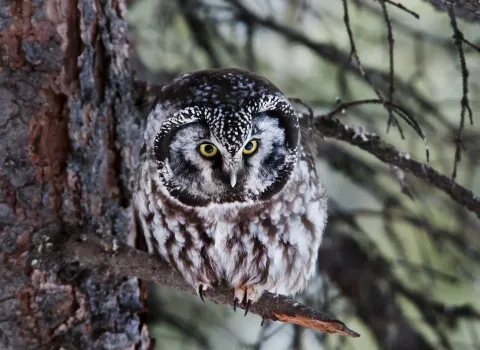
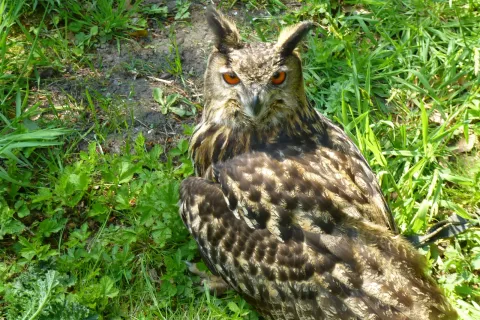
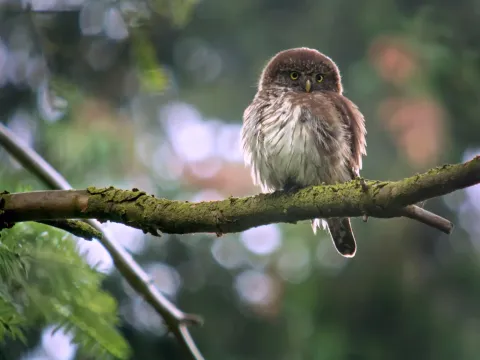
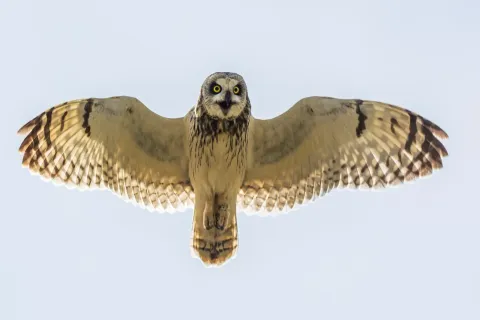
Photo: Becky Matsubara, CC BY 4.0, via Wikimedia Commons, resized

Photo: Ancalagon, CC0, via Wikimedia Commons, resized

The text was written with AI from facts in Wikipedia and may be shared under CC BY-SA 4.0. Sources: Swedish article, English article, German article
Report data: Artportalen (SLU Swedish Species Information Centre) via GBIF.org, 2016 to 2025. Red list: The Swedish Red List 2025, SLU Swedish Species Information Centre via GBIF.org.
Checked against sources on . How we make these pages