Strigidae
Short-eared Owl
Asio flammeus
- Scientific name
- Asio flammeus
- Family
- Strigidae
- In Sweden
- Partial migrant, breeds here
- Size
- 33 to 40 cm
- Swedish Red List 2025
- Near threatened (NT)
- Global Red List (IUCN)
- Least concern (LC)
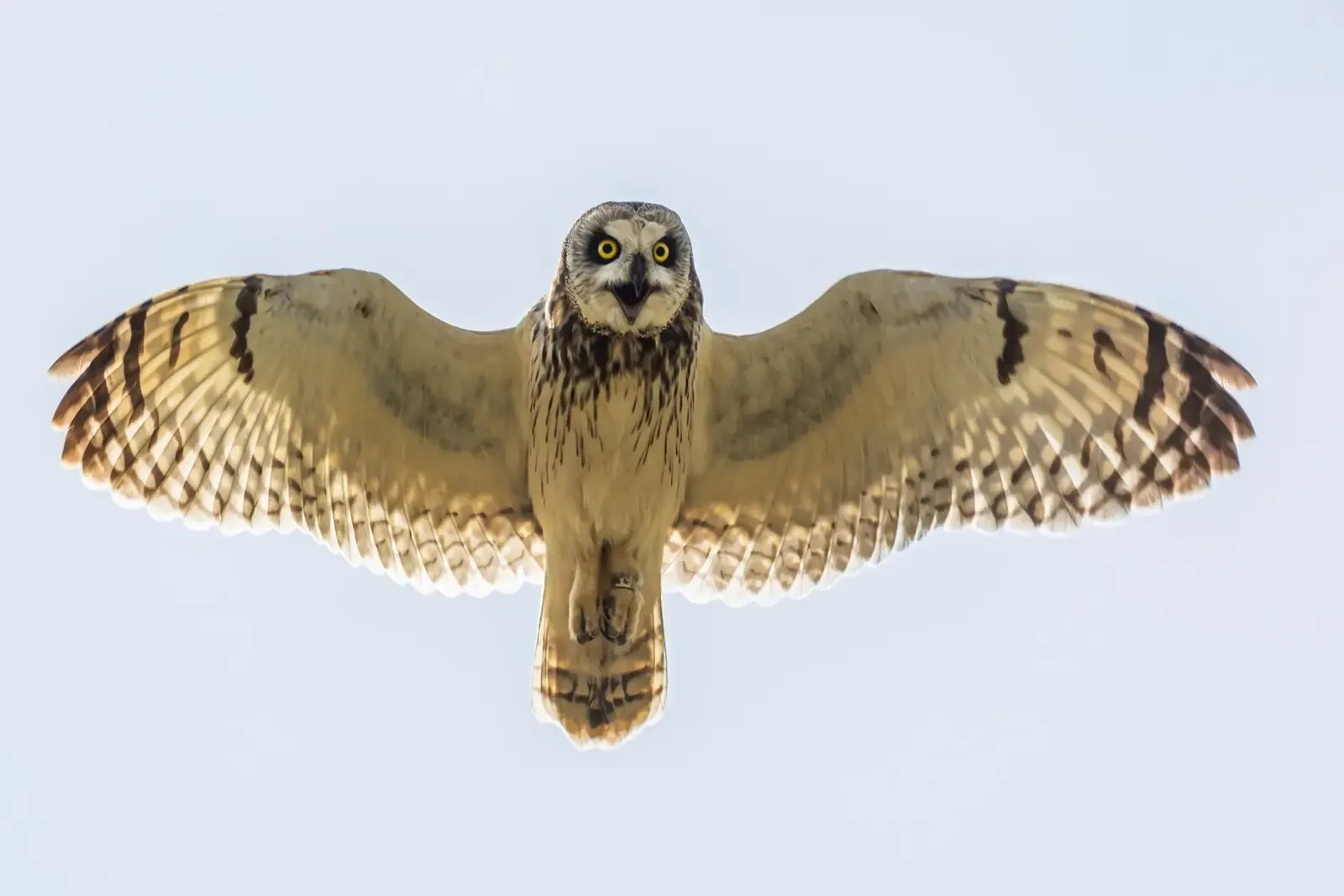
The Short-eared Owl is a medium-sized owl with very long, narrow wings. It breeds on heaths, bogs, mires and clear-cuts, in Sweden mainly in the northern half of the country.
How to recognise it
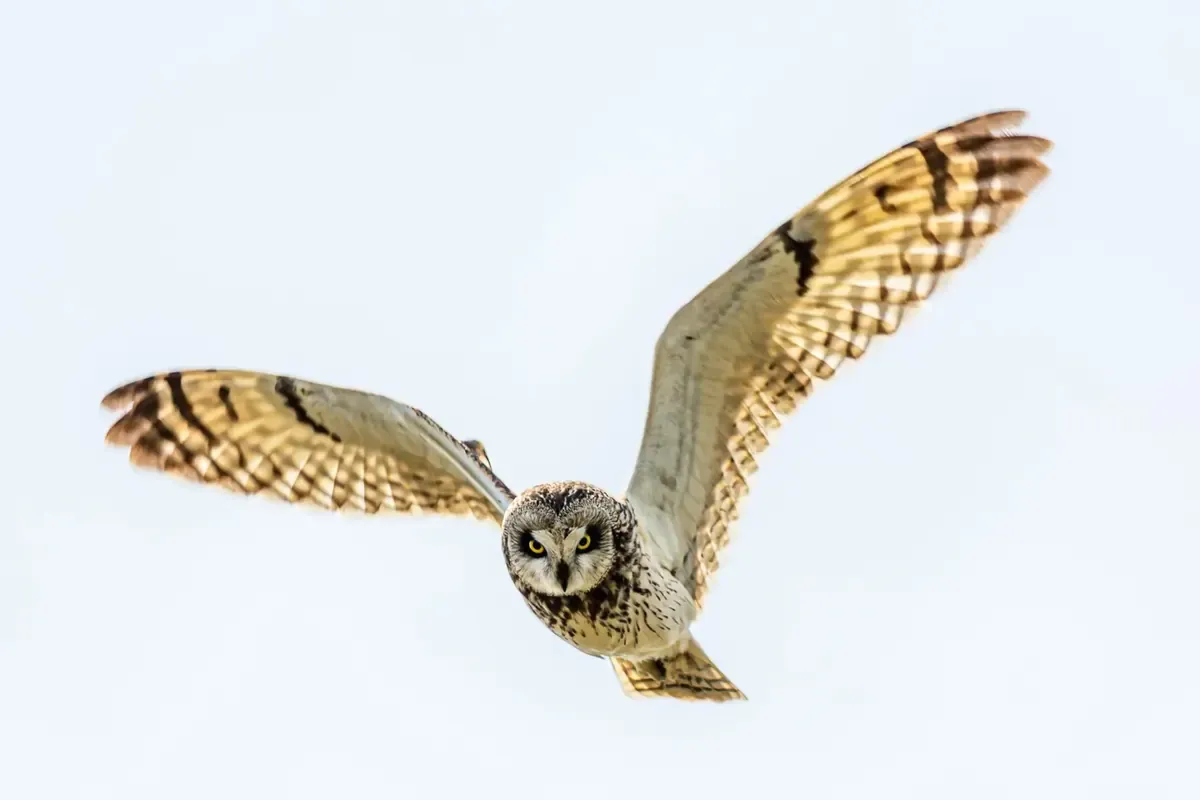
- Very long, narrow and fairly pointed wings with black wingtips
- Pale face and yellow eyes ringed with black, ear tufts usually not visible
- Coarsely streaked breast on a buff ground, contrasting with the pale belly
- Dark crescent-shaped patch at the wrist, male and female alike in colour
Call and song
The male's song, often given high up in flight, is a rapid series of deep po-po-po, usually 6 to 20 syllables. The female begs with a hoarse, drawn-out tjerr-app and gives a rasping tjeff-tjeff-tjeff in alarm. It also claps its wings together in quick succession, a rattling sound like a flapping flag. It is silent in its winter quarters.
Where and when
It is a partial migrant that breeds in Sweden, mainly in Norrland, and also on clear-cuts in central Sweden, on southern Öland and on bare archipelago islands in the south. It returns in April to May and is reported most in May and October. Some birds winter in southern and central Sweden, north to about the latitude of Småland. It is red-listed as Near Threatened and declining.
When is it seen in Sweden?
Where is it reported?
- No reports
- Small share
- Medium share
- Large share
Reported most in May and October. Rarely reported in August. Its share of all bird reports is highest in Norrbotten, Västerbotten and Jämtland.
Food and behaviour
It mainly catches small rodents, especially voles, and also other small animals as well as birds and their young. It hunts mostly at dusk and in the morning and is more active by day than many other owls. Its flight is light and almost slow-motion, often gliding on stiff wings. The nest is a hollow in the ground, and the female incubates while the male feeds her.
Easily confused with
-
Asio clamator
Asio clamator always shows its ear tufts and has a broadly black-edged facial disc, while the Short-eared Owl's ear tufts are usually not visible. It is also slightly smaller.

More in the Strigidae family


Photo: Stephan Sprinz, CC BY 4.0, via Wikimedia Commons, resized

Photo: Stephan Sprinz, CC BY 4.0, via Wikimedia Commons, resized

The text was written with AI from facts in Wikipedia and may be shared under CC BY-SA 4.0. Sources: Swedish article, English article, German article
Report data: Artportalen (SLU Swedish Species Information Centre) via GBIF.org, 2016 to 2025. Red list: The Swedish Red List 2025, SLU Swedish Species Information Centre via GBIF.org.
Checked against sources on . How we make these pages