Strigidae
Ural Owl
Strix uralensis
- Scientific name
- Strix uralensis
- Family
- Strigidae
- In Sweden
- Resident all year
- Size
- 50 to 59 cm
- Swedish Red List 2025
- Not red-listed
- Global Red List (IUCN)
- Least concern (LC)
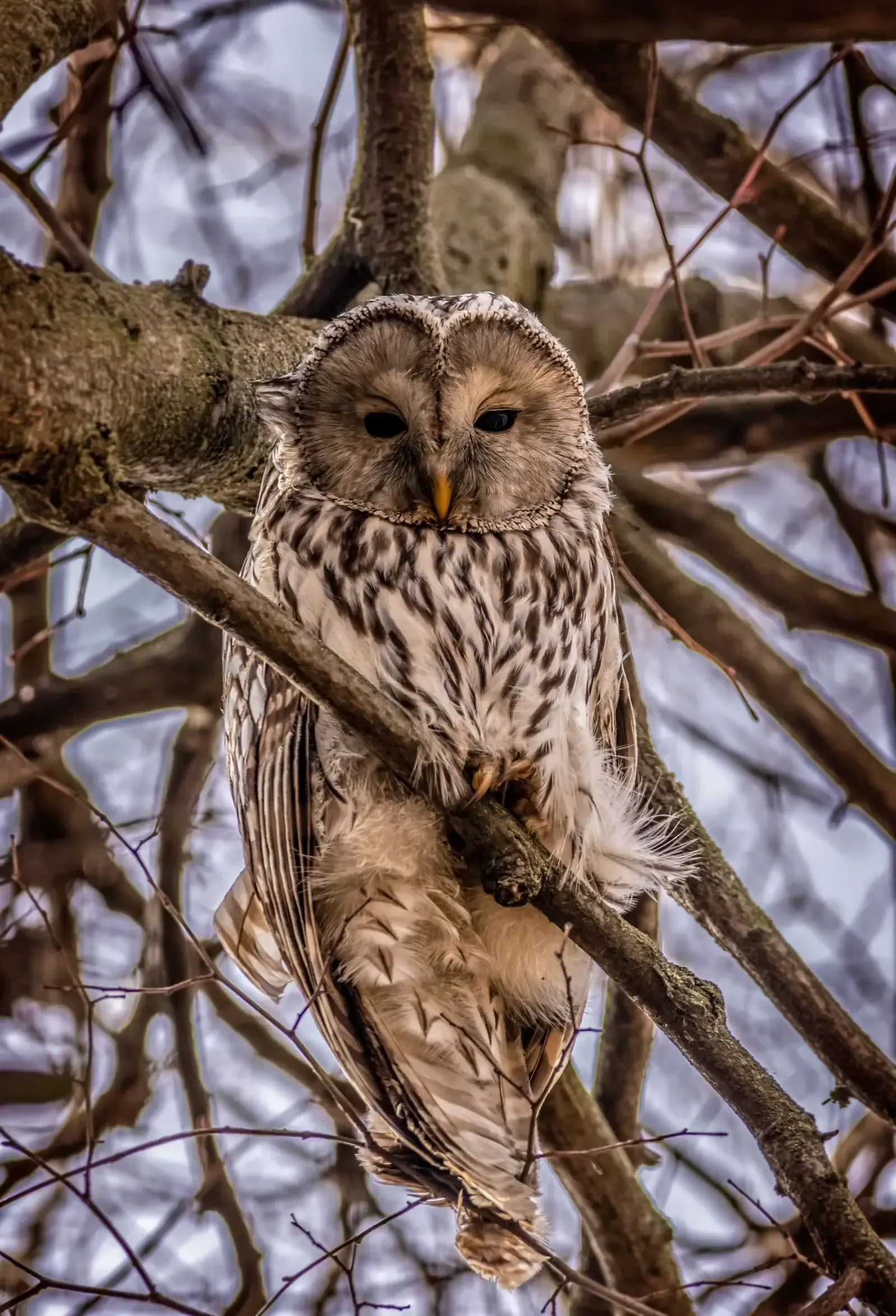
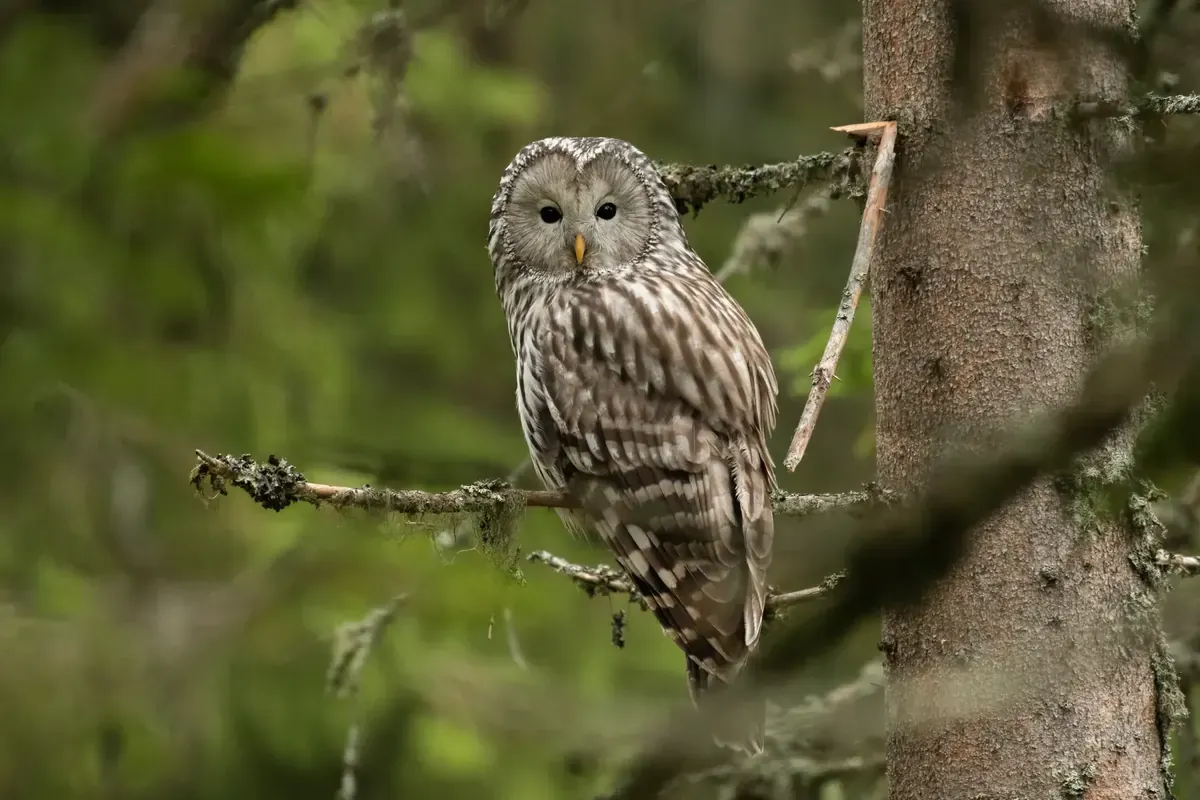
The Ural Owl is a pale greyish brown owl and a resident in Sweden, where it occurs from northern Västmanland to Lule lappmark. It lives in taiga with thick-trunked trees and bogs, and where forest meets farmland.
How to recognise it
- Pale greyish brown, paler than Tawny Owl, round head and fairly flat facial disc
- Small black eyes and an orange-yellow bill
- Whitish underparts with narrow brown streaks and a wedge-shaped, evenly barred tail
- The sexes look alike, but the female is slightly larger and on average much heavier
Call and song
The male's song is a deep, rhythmic hooting of seven syllables. The female's song is similar but hoarser and slightly higher. The contact and alarm calls are harsh and nasal and sound like a barking dog.
Where and when
The Ural Owl is a resident in Sweden and occurs from northern Västmanland to Lule lappmark, most numerous from Uppland to Medelpad. North of the Arctic Circle it is very rare. It is reported most in February and March and rarely reported in August and September. Its share of all bird reports is highest in Uppsala, Västmanland and Dalarna.
When is it seen in Sweden?
Where is it reported?
- No reports
- Small share
- Medium share
- Large share
Reported most in February and March. Rarely reported in July to September. Its share of all bird reports is highest in Uppsala, Västmanland and Dalarna.
Food and behaviour
The female defends the territory while the male brings food for the family. It is very aggressive when the young leave the nest and may attack people nearby. With young in the warm season, it is often active at midday. Its flight recalls a Common Buzzard, with deeper, more relaxed wingbeats.
Easily confused with
-
The Tawny Owl is much smaller, with a clearly shorter tail and a relatively larger head. Its underparts have dark streaks and bars, while the Ural Owl has bold straight streaks.
-
Strix nebulosa
The Great Grey Owl is larger, with a huge head, small yellow eyes and clear concentric rings in the facial disc.
More in the Strigidae family
Photo: Andrew Kalinin, CC BY 4.0, via Wikimedia Commons, resized

Photo: Divlja Srbija, CC BY-SA 4.0, via Wikimedia Commons, resized

The text was written with AI from facts in Wikipedia and may be shared under CC BY-SA 4.0. Sources: Swedish article, English article, German article
Report data: Artportalen (SLU Swedish Species Information Centre) via GBIF.org, 2016 to 2025. Red list: The Swedish Red List 2025, SLU Swedish Species Information Centre via GBIF.org.
Checked against sources on . How we make these pages