Anatidae
Whooper Swan
Cygnus cygnus
- Scientific name
- Cygnus cygnus
- Family
- Anatidae
- In Sweden
- Partial migrant, breeds here
- Size
- 140 to 160 cm
- Swedish Red List 2025
- Not red-listed
- Global Red List (IUCN)
- Least concern (LC)
The Whooper Swan is a white swan that breeds in wetlands rich in vegetation throughout Sweden, from forest lakes to farm ponds, streams and wet bogs. Outside the breeding season it is sociable, and lately it also feeds on farmland like geese.
How to recognise it
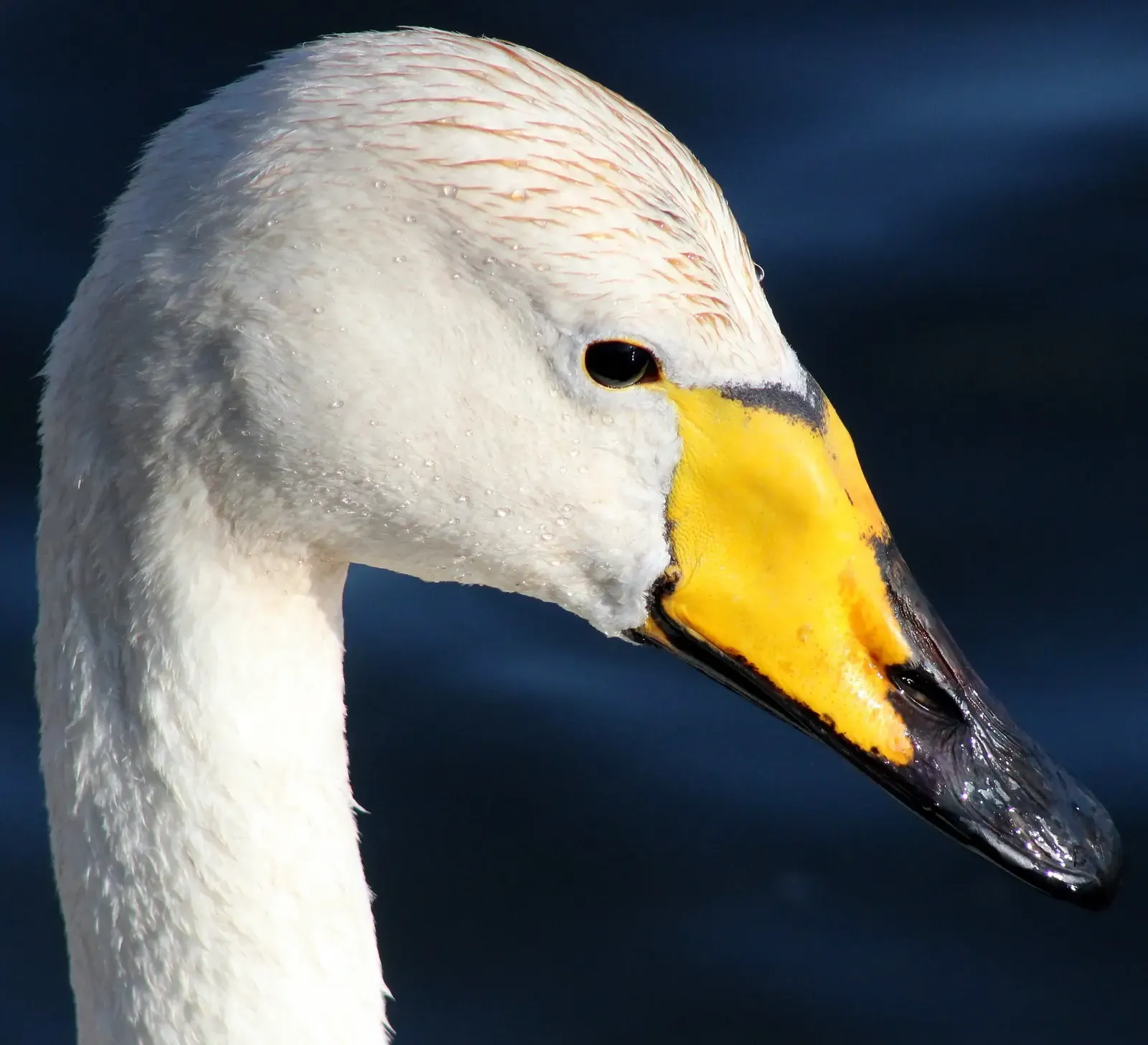
- White, with a bright yellow bill base, the bill tip and lower part black
- The yellow on the bill reaches below the nostril
- Usually a straight neck and a pointed head, the bill continuing from the sloping crown
- Young birds are greyish brown-white, and females are clearly smaller than males
Call and song
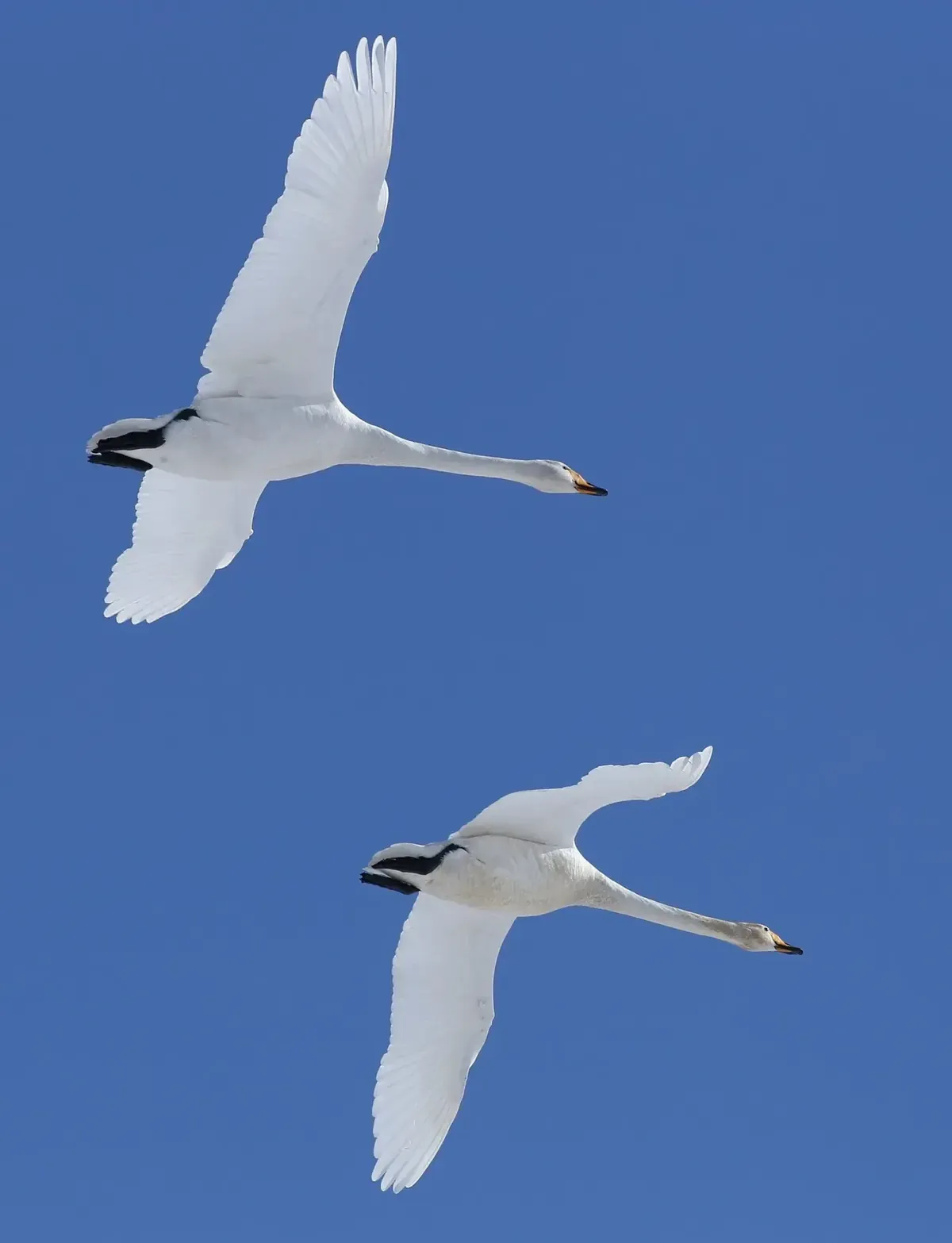
In flight it gives a loud, trumpeting call in groups of three or four notes, written as kloo-kloo-kloo. The wings make only a quiet swishing, unlike the loudly singing wingbeats of the Mute Swan.
Where and when
It is a partial migrant breeding throughout Sweden, with the largest populations in Norrbotten, Västerbotten and Gävleborg counties. Autumn migration to southern Sweden, Denmark and the North Sea countries starts in October, and spring migration north around the turn of February and March. Spring stopover sites include Hornborgasjön, Tysslingen, Väster-Färnebo and the Ume River delta. It is reported from all 21 counties, most in February, March, November and December.
When is it seen in Sweden?
Where is it reported?
- No reports
- Small share
- Medium share
- Large share
Reported most in February, March, November and December. Reported from all 21 counties.
Food and behaviour
It feeds on plants and plant parts, lately also on farmland like geese. Outside the breeding season it is sociable. Pairs form for life, and the nest is often very large and built mostly from plant material from the lake bottom. The female lays four to seven butter-coloured eggs. On migration it usually flies at 50 to 200 metres altitude at up to 100 km/h.
Easily confused with
More in the Anatidae family
Photo: Estormiz, CC0, via Wikimedia Commons, resized

Photo: Estormiz, CC0, via Wikimedia Commons, resized

The text was written with AI from facts in Wikipedia and may be shared under CC BY-SA 4.0. Sources: Swedish article, English article, German article
Report data: Artportalen (SLU Swedish Species Information Centre) via GBIF.org, 2016 to 2025. Red list: The Swedish Red List 2025, SLU Swedish Species Information Centre via GBIF.org.
Checked against sources on . How we make these pages